
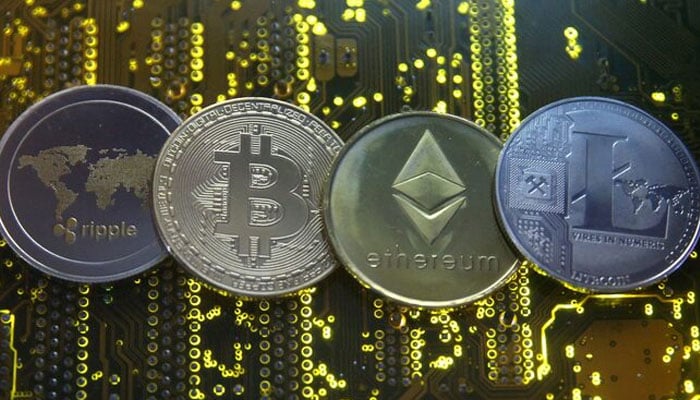

Amid increasing fraud and criminal cases related to cryptocurrencies in the country, the government has started reviewing proposals to introduce regulations for cryptocurrency and blockchain technology, it was reported on Monday.
With the possibility of a law being introduced soon, officials have said that the government was not only reviewing proposals for regularising cryptocurrency and blockchain but also considering the introduction of a Pakistani digital currency to strengthen the Pakistani rupee.
A proposal is being considered for the introduction of a digital currency backed by the Pakistani rupee, which would have legal status under the State Bank of Pakistan (SBP) laws.
The development comes as ruling party Pakistan Muslim League-Nawaz’s (PML-N) Senator Dr Afnan Ullah Khan introduced the Virtual Assets Bill 2025 — a groundbreaking piece of legislation aimed at establishing a regulatory framework for the rapidly growing digital asset market, including cryptocurrencies and blockchain technologies, in the country.
This bill seeks to regulate and formally manage the virtual assets sector in Pakistan to ensure that it operates within a legal framework.
The bill aims to address key issues such as security, fraud prevention and market stability. The proposed legislation comes at a time when digital assets are gaining global popularity, and the country is striving to align with international standards to protect the interests of investors and consumers.
Country’s economic hub, Karachi, recently witnessed a shocking incident where private individuals and police personnel allegedly collaborated in a short-term kidnapping.
The victim, Arsalam Malik, a businessman associated with cryptocurrency, was abducted, and 340,000 USDT (a cryptocurrency) was transferred from his account to those of the perpetrators.
When this development surfaced in the media, it spread like wildfire, especially given the rising interest in digital currencies in the country. Just like in other parts of the world, thousands or even millions of Pakistanis are investing in cryptocurrency and showing interest in the digital currency market.
However, this incident has amplified the concerns of those already apprehensive about the lack of a clear government policy on cryptocurrency. The absence of a decision by the government on whether digital currencies are legal or illegal has also left investors in a state of uncertainty.
This ambiguity has not only paved the way for various forms of fraud but also discouraged victims from filing complaints due to fear and distrust.
The recent short-term kidnapping case has heightened fears among cryptocurrency traders and investors. In addition to the risk of scams, they now face the alarming possibility of being abducted and robbed of their digital assets.
The regulatory vacuum has enabled fraudulent activities to thrive, with some individuals within institutions taking advantage of the situation to exploit unsuspecting citizens.
While fraud cases related to cryptocurrency have been reported in the past, this incident stands out as the first of its kind where police personnel allegedly partnered with private individuals to execute a digital robbery through a short-term kidnapping.
Experts emphasise that if the government were to legalise cryptocurrency, Pakistan could align itself with global trends while addressing domestic concerns.
Recognising and regulating cryptocurrency firms would not only ensure traceability but also drastically reduce the prevalence of fraud.
Since the rise of crypto around 2015-16 in Pakistan, nearly two dozen cases have been registered across the country pertaining to crime involving digital currency. Out of these, almost half were filed with the Federal Investigation Agency’s (FIA’s) Cybercrime Circle in Karachi alone.
Nadir Khan, a journalist who has covered such cases, said the core issue lies in the absence of a clear policy on cryptocurrency from the government.
“Whenever courts inquire about crypto-related cases, the government’s stance remains ambiguous, stating that they are still deliberating on whether to declare cryptocurrency officially illegal or legal. Until its status is officially determined, it remains a grey area, effectively treated as illegal.”
He added that the lack of a clear policy from the government has created an environment where fraud is rampant, and many individuals and companies operating in the cryptocurrency space in Pakistan are forced to do so discreetly.
“Not all of these companies are fraudulent — several are legitimate — but they too are compelled to operate under the radar due to the absence of proper regulation,” Khan explained.