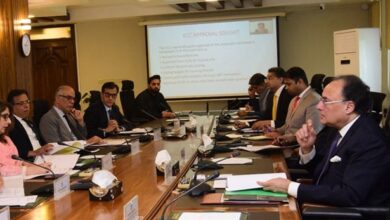

The State Bank of Pakistan will maintain the policy rate at 7% for the next two months, the Monetary Policy Committee (MPC) said in a statement on Friday.
Since its last meeting in March, the MPC was encouraged by the further upward revision in the FY21 growth forecast to 3.94%, the statement said.
“The MPC noted that this confirms the strength of the broad-based economic rebound underway since the start of the fiscal year, on the back of targeted fiscal measures and aggressive monetary stimulus,” it said.
This positive momentum is expected to persist, translating into higher growth next year, the statement added.
Inflation rose to 11.1% year-on-year in April, propped up by the lingering impact of this February’s electricity tariff increase as well as a pick-up in month-on-month food prices, partly driven by the usual seasonality around Ramzan, the MPC noted.
The committee also forecast that the year-on-year inflation rate is “likely to remain elevated in the coming months due to the recent electricity tariff hike”. It said that the tariff hike would push the “average for FY21 close to the upper end of the announced range of 7-9%”.
Why maintain the policy rate
Explaining its reasoning for not changing the policy rate, the MPC said the current stance “remains appropriate to ensure the recovery becomes firmly entrenched and self-sustaining”.
“This is especially so given the renewed heightened uncertainty created by the on-going third wave of COVID in Pakistan and the fiscal consolidation expected this fiscal year. As a result, the MPC noted that it was important for monetary policy to remain supportive,” read the presss release.
The MPC also said that in the future, if no unforeseen circumstances come, then the monetary policy will “remain accommodative in the near term”. It added that “any adjustments in the policy rate” will be “measured and gradual to achieve mildly positive real interest rates over time”.
“If demand side pressures emerge as the recovery becomes more durable and the economy returns to full capacity, the MPC noted that it would be prudent for monetary policy to begin to normalise through a gradual reduction in the degree of accommodation,” said the press release.
The MPC said that the move would help ensure that inflation remains in check and “does not become entrenched at a high level and financial conditions remain orderly” which would result in “sustainable growth”.
Real sector
The MPC said that the latest National Income Accounts data shows that the “economy has rebounded strongly from last year’s severe COVID-shock, led by services and industry”.
The committee estimated that the industrial sector has grown 3.6% during FY21 and was “driven by construction and large-scale manufacturing, especially the food, cement, textile and automobile sectors”.
The MPC also estimated that the agriculture sector has grown 2.8%, as the production of wheat, rice and maize reached “record highs”. It also credited the increase to sugarcane which rose to the second-highest ever level.