
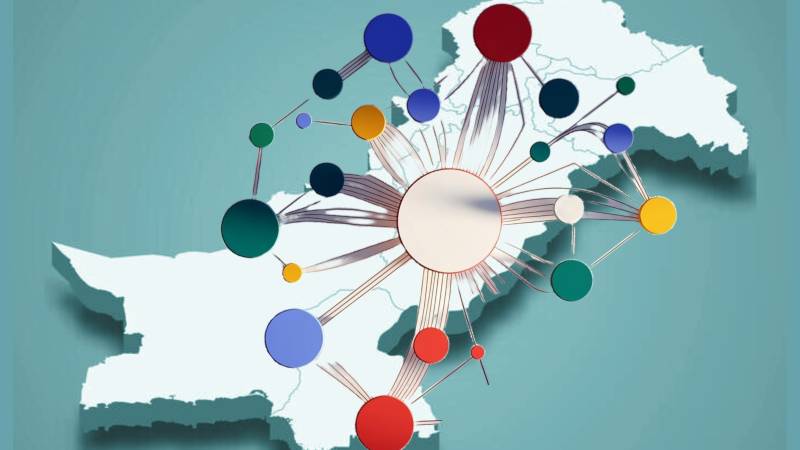

The policy landscape in Pakistan is often characterised by fragmented planning, weak intergovernmental coordination, and a limited feedback mechanism between policy formulation and implementation. National strategies often lose momentum at the federal, provincial, and district levels due to overlapping sectoral mandates, inadequate communication paths, and a lack of systematic monitoring and evaluation as recent highlights in Governance and corruption Diagnostic Report by International Monetary Fund (IMF). To overcome this challenge, the emerging concept of the new “Network Graph Model” has the potential to occupy a space in the literature, with logical and mathematical algorithms backing, offering policymakers a structured approach to understanding how influence and coordination flow through complex policy systems. This graph model has the ability to support decision-makers to identify where authority resides, how coordination occurs, and where feedback requires to mitigate the pressure points where corruption can intensify. It also represents a deterministic, rule-based structure that balances central influence, layered propagation, and modular clustering, with unique characteristics including a designed tier structure, analytical edge formulas, influence quantification among elite actors, and direct policy implications, making it more suitable for representing a real-world governance network in Pakistan.
At first glance, this model looks like art, but upon closer inspection, it reveals a perfectly symmetrical web of colored nodes orbiting around a single stable core. The central green node (or vertex) acts as a hub, connecting directly to many other nodes through edges and encircling multiple concentric layers of nodes. These layers likely represent levels of connectivity or influence among authority, resources, and decision flow across Pakistan’s governance system. This graph model supports to identify the influences from the perspective of their distance from the central hub (authority)—first-order, second-order, and so on. Each color—green, red, blue, and yellow—represents chromatic number; a category, type, or functional cluster of nodes such as authority (green), structure (yellow), transparency (blue), high risk/ corruption nodes (red). The network is radially symmetric, illustrating a hierarchical or multi-tiered structure where influence and directions flows outward. This graph model is based on a key idea: influence in public systems spreads through intentional layers of authority and interaction, not by chance. The central hub represents strategic leadership or policy vision, with the surrounding middle rings reflecting stages of implementation, coordination, and community engagement by technical teams, and the outer rings representing field implementers. This structure provides a clear, visual method for understanding how policy ideas progress from formulation to impact.
Traditional network theories, such as scale-free, small-world, random, and tree models, address randomness and self-organization but do not capture governance structures with defined influence. This conceptual graph model incorporates hierarchy and interdependence, providing both structure and flexibility. It clarifies multi-tier decision-making, shows how influence is distributed, and identifies opportunities to improve decision speed, communication, and coordination. The model makes policy implementation structures visible and measurable, and supports feedback-based policymaking through two-way connectivity (edges) between core and network layers. This approach enables top-down decision-making and bottom-up learning, which are essential for adaptive governance in dynamic environments.

This network graph model enhances graph and systems theory by introducing intentionality and balance to network analysis. It treats policies as structured processes that depend on flow, coherence, and accountability. The network graph model clarifies these elements by integrating vision, implementation, and accountability in a single framework. As policies increasingly address interconnected challenges, structural clarity becomes as important as content. By bridging network science and governance, the model transforms theory into a practical framework. Policy analysts can use it to identify bottlenecks where elite capture recycle influence, quantify stakeholders’ chokepoints prone to rent-seeking, exposes hidden edges enabling policy manipulation, visual mapping of corruption pathway, and support Ministry of Finance (MoF), and Auditor General of Pakistan (AGP) to prioritize oversight based on systemic risks. The model enables both vertical and horizontal alignment among government, political, private, and informal actors in complex governance areas. It facilitates the mapping of collective decisions, supporting equilibrium in conflict games, negotiation, and also geopolitical analysis. Applications include waste management, environmental management, urban planning, risk management, security, communication, accountability, and command structures. Additionally, the model allows governance to be represented as a calculable network, extending traditional theory to structured policy, resilience, and impact modeling.