
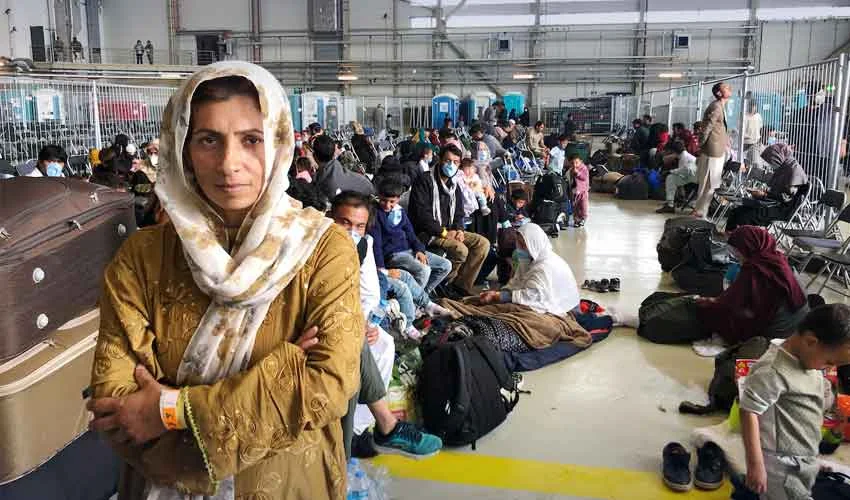

Germany has announced an immediate end to its Afghan refugee resettlement program, revoking earlier commitments and blocking hundreds of Afghans from entering the country, citing security concerns and shifting political priorities.
Germany has taken a tough stance against Afghan refugees by ending its resettlement program with immediate effect. According to German broadcaster DW News, all previous promises and commitments made to Afghan refugees have been withdrawn.
As a result, 640 Afghan citizens who were waiting in Pakistan to relocate to Germany will no longer be allowed to enter.
Interior Ministry confirms end of political support
German Interior Ministry spokeswoman Sonja Kock said Afghans who had been promised relocation would soon be informed “that there is no longer any political interest in their admission.” She confirmed that the resettlement options for Afghan refugees waiting to come to Germany have effectively ended.
Kock added that the decision reflects a broader political shift away from migration programs.
Coalition agreement drives policy reversal
The move follows an agreement by Germany’s ruling coalition — the conservative CDU and CSU parties and the Social Democrats — to scrap Afghan resettlement programs “as far as possible.” Chancellor Friedrich Merz has backed stricter migration controls, citing crimes involving Afghan refugees and serious security concerns.
The decision marks a clear departure from the policies of the previous government.
After the Taliban seized power in Afghanistan in 2021, Germany pledged asylum to vulnerable Afghans, including women’s rights activists, lawyers, journalists and opposition figures. These admissions were managed through the so-called “human rights list” and “bridging list.”
Interior Minister Alexander Dobrindt later reversed these commitments, dismissing them as “legacy issues” inherited from the previous administration.
Afghan local staff also affected
For the first time, Germany’s third resettlement program for Afghan local staff who worked for German ministries has also been impacted. According to aid group Kabul-Luftbrücke, around 130 former local staff and their families were informed via email that they would no longer be admitted.
The email, sent by Germany’s development agency GIZ, stated that there were “no grounds for granting admission to Germany under Section 22 of the Residence Act,” without offering specific reasons.
Sonja Kock confirmed that of the 220 remaining local staff, only 90 can still claim admission. Interior Minister Dobrindt said he was not fully aware of the developments but insisted Germany would honor legally binding commitments where they exist.
He emphasized that admission remains conditional on passing security checks.
Thousands previously accepted since 2021
Government data shows Germany has accepted around 4,000 Afghan local staff and nearly 15,000 family members since the Taliban takeover in 2021 until April 2025. In comparison, the group currently stranded in Pakistan is relatively small.
Still, the uncertainty surrounding their future has caused deep anxiety.
With Pakistani authorities threatening to hand over Afghans staying in German guesthouses to the Taliban at the turn of the year, time is running out. Although several hundred Afghans have been relocated since the current government took office, about 1,000 people remain in limbo.
Under the fourth resettlement program, they were promised relocation, but most pledges have not been honoured.
Lawsuits offer last hope for some refugees
Only Afghans who successfully sue the German government are still being allowed to travel. According to Kabul-Luftbrücke, 84 lawsuits have succeeded, while 195 more are pending, with dozens additional cases in preparation.
It remains uncertain whether these legal proceedings can conclude before the end of the year.
“This is an unbelievable state of uncertainty,” said Eva Beyer, spokesperson for Kabul-Luftbrücke, referring to Afghans stranded in Pakistan. She described the prolonged limbo as “psychological torture” for people who have already lived in fear for years.
Over four years, about 3,500 commitments were made under the resettlement program, mainly to former employees of German NGOs at risk from the Taliban.
Around 250 organizations, including Human Rights Watch, Pro Asyl and Brot für die Welt, have sent an open letter urging Interior Minister Dobrindt to bring endangered Afghan families to Germany before year-end without bureaucratic delays.
Helen Rezene, co-director of Pro Asyl, called the situation a “litmus test” for Germany’s reliability, credibility and humanity.
Limited support but uncertain future
Kock said affected Afghans would not be immediately homeless and could remain in rented guesthouses in Pakistan as long as the Afghanistan-Pakistan land border stays closed. Germany has also offered to book flights back to Kabul, though officials acknowledge that the refugees’ fate there would be completely unclear.