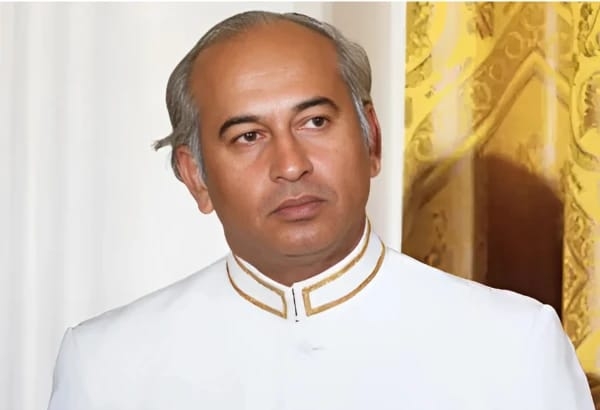

Pakistan is observing the 98th birth anniversary of former prime minister and founder of the Pakistan Peoples Party (PPP), Zulfikar Ali Bhutto, today (Monday), with commemorative events taking place across the country.
The main ceremony is being held at Bhutto’s mausoleum in Garhi Khuda Bakhsh, where party leaders and workers gathered after a recitation of the Holy Quran. Floral wreaths were laid at his grave and special prayers were offered for the late leader.
Similar events are being organised in major cities and small towns nationwide. Senior and local PPP leaders are addressing gatherings to reflect on Bhutto’s political journey, ideology, and vision for Pakistan. Birthday cakes are also being cut at the end of the ceremonies to mark the occasion.
Zulfikar Ali Bhutto was born on January 5, 1928, in Larkana. His father, Sir Shah Nawaz Bhutto, served as the dewan of the former princely state of Junagadh. Bhutto received his education in the United States and the United Kingdom, studying at the University of California, Berkeley, and the University of Oxford, before qualifying as a barrister from Lincoln’s Inn.
He entered national politics at a young age and served in the cabinet of President Iskander Mirza. During the military rule of President Ayub Khan, he held several key ministerial portfolios, gaining prominence as a dynamic political figure.
In 1967, Bhutto founded the Pakistan Peoples Party, which quickly emerged as a major political force. Following the 1971 war, he served as Pakistan’s fourth president from 1971 to 1973. After the unanimous adoption of the 1973 Constitution, he became prime minister on August 14, 1973.
The PPP won the general elections in 1977, but the results were challenged by an opposition alliance, leading to widespread protests and political unrest. On July 5, 1977, then army chief General Ziaul Haq imposed martial law, citing the deteriorating law-and-order situation.
Bhutto was later arrested and tried in a murder case, a process that has remained controversial for decades. On April 4, 1979, he was executed at Rawalpindi Jail, a moment widely seen as a turning point in Pakistan’s political history.
Commenting on the anniversary, Karachi Mayor Murtaza Wahab said Bhutto’s execution effectively ended an era of popular politics in the country. He added that in a later presidential reference, the Supreme Court acknowledged that Bhutto’s trial did not meet the standards of justice, reinforcing long-standing concerns over the fairness of the judicial process.