
Pasni, a peripheral town in Balochistan that has entered the international news, has more to offer
than serene plains, Makran's rocky hills, and pristine beaches alongside the Arabian Sea. The
town attained strategic attention during early October 2025 when the Financial Times released a
statement claiming that Islamabad had allegedly explored pitching Washington on the
development of a new port, specifically at Pasni. The news raised a plethora of questions and
arguments among netizens. For conservatives, it was an astounding opportunity to develop naval
security; for nationalists, it was a tool to reassert Pakistan’s strategic autonomy, whereas post-
Colonial critics argued that it risked foreign extraction and dependency, and academics
questioned how a long-overlooked port had suddenly gained such relevance. Meanwhile, the
port’s significance as a strategic counterbalance between two great powers, China and the US
also sparked a captivating debate reflecting its geopolitical middle game and its role in
promotion of the blue economy.
1. Introduction: From A Strategic Imperial Link to Balochistan Today
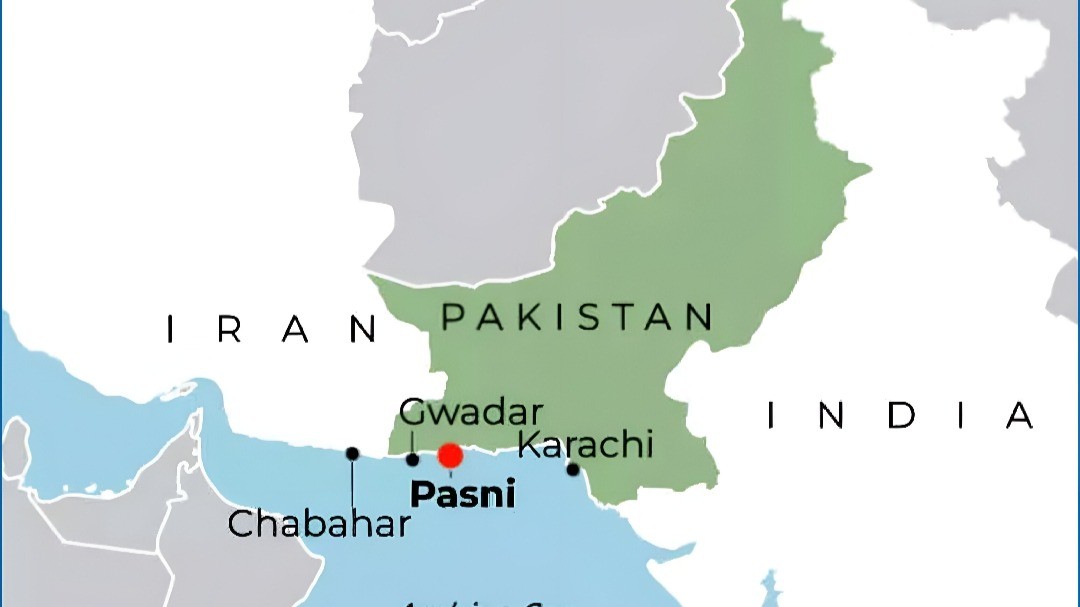
450km away from Karachi, near the Makran coast, the town of Pasni hosts Pasni Port that serves as a
fishing harbour and a naval base. While the port unfolds in it a historical relevance by serving as
a strategic imperial link, it also equips Balochistan with maritime relevance across Gwadar in the
twenty-first century. It lies close to major Sea Lines of Communication (SLOCs) in the Arabian
Sea and is located near the Strait of Hormuz, a chokepoint vital for global energy flows. Its
coastal environment offers relatively stable maritime operations. Historically, such geography
has never gone unnoticed by the colonial hegemon. During the British colonial period, Pasni
functioned as a strategic communication link on the Makran coast, hosting telegraph lines and
serving as a buffer zone amid imperial rivalries involving Persia and Russia. Geography once
again brings Pasni back into strategic relevance.
2. Geopolitical Middlegame: A tool for Counterbalancing
Yet Pasni’s renewed importance is not solely a function of geography; it is strongly influenced
by the fact: What the port is NOT. Unlike Gawadar, which has become deeply embedded within
the China-Pakistan Economic Corridor (CPEC) and the Belt and Road Initiative (BRI), Pasni remains
politically unencumbered by formal mega-project frameworks. This relative insulation grants
Islamabad’s strategic flexibility. In a region increasingly polarised by great-power competition,
Pasni offers Pakistan a maritime asset that is neither overly securitised nor externally branded.
Hence, premising a room for calibrated engagement without ‘symbolic’ overcommitment.
As the geography emphasises the uniqueness of the port, it also poses a question on Pakistan’s
other ports. When Ports such as Karachi and Port Qasim are congested, over-commercialised
and vulnerable to urban saturation and soaringly ambitious Gwadar Port carries intense
geopolitical signalling and security externalities: which port promises Islamabad the strategic
middleground? Pasni, by contrast, offers modesty in scale while owing strategic geography,
limited operations, and most importantly, political agility. Its value is redefined more in its potential
as a supportive maritime node, a backup, a buffer, and a balancing instrument within Pakistan’s
broader port strategy.
While the critics argue on the notion, history grants sheer evidence dated back to 2001,
highlighting Pasni as a buffer. During the early stages of Operation Enduring Freedom, following
the attacks of September 11, 2001, Pakistan permitted the limited use of Pasni for logistical and
refuelling purposes to support operations in Afghanistan. Notably, this cooperation remained
narrowly defined and excluded involvement in actions against Iran. This also illustrates Pasni’s
strategic character, allowing it to establish engagement without entanglement and directs towards
reassertion of Islamabad's capacity to engage multiple power centres without subsuming its
maritime assets under any single bloc. Thus, Pasni embodies what may be described as
Pakistan’s maritime “middle-game” through a balanced approach.
3. Promotion of Blue Economy: Pathway for Locally Empowered Blue
Economy
Beyond the geopolitical chessboard, Pasni’s most tangible prospect lies in the locally empowered
Blue Economy, particularly fisheries. Primarily, the port functions as a fishing harbour,
facilitating fresh seafood shipments to Karachi and inland Balochistan, with export potential
extending to EU-compliant markets. Although Pasni falls under Pakistan’s Maritime Affairs
Secretariat is operated by the Balochistan Port Authority, reflecting that the port is a national
asset, but Balochi locals play a pivotal role in maintaining the blue economy.
Policy research, including Javed Akhar’s 2023 Policy Monograph onthe revival of Pasni Fish
Harbour identifies siltation and inadequate dredging as the principal causes of operational
decline. Addressing these technical constraints through professional dredging is not a mere
theological recommendation, but a necessary precondition for restoring berth accessibility,
improving turnaround times and safeguarding fishing vessels; therefore, directly impacting
incomes and employment.
The socio-economic implications are somewhat measurable. Between 2014-2015 and 2019-
2020, household expenditure on essential services in Pasni stagnated, reflecting limited growth in
purchasing power despite sustained economic activity. Reviving harbour functionality would
therefore not merely increase output but translate maritime activity into local consumption,
addressing long-standing development gaps in coastal Balochistan.
Most significantly, Pasni’s blue economy also intersects with security and stability. Local-
oriented investment reduces resentment by embedding economic gains within the community
rather than externalising them. In a province where alienation has undermined governance and
intelligence sharing, Pasni MAY grant a region for economic anchor and peace building. Yet this
potential remains contingent. Smuggling networks, drug trafficking routes, militancy affecting
road access along the Makran Coastal Highway, weak regulatory oversight, and infrastructure
deficits continue to constrain outcomes. Acknowledging these challenges is essential, not to
diminish Pasni’s value, but to underscore that economic normalisation, rather than militarisation,
is the port’s most sustainable strategic function.
“The world is not what it seems, but it isn’t anything else, either”- Raymond Queneau
Coming from a pre-med background, the irony of international relations is striking. Unlike
sciences, the IR world rarely operates as the theory predicts. Pasni port is a textbook example of
this. The much-discussed “pitching” of Pasni to Washington never materialised into a formal
initiative, and it’s not difficult to see why:
Neither Pakistan’s maritime fiscal priorities nor America’s strategic calculus justify deep
investment in a high-risk, underdeveloped port when more stable, commercially viable
alternatives exist across the region.
In simpler terms, Pasni is not a short-term plan but a long-term commitment. Ports like
Pasni would not emerge through grand announcements or immediate foreign investments.
Although they may attain strategic attention on headlines for a while, they acquire slow
institutional repair, local economic revival and increased incremental connectivity.