
Chief Justice of Pakistan (CJP), in his capacity as Chairman of the Law and Justice Commission of Pakistan (LJCP), visited the Judicial Complex in Fort Abbas, District Bahawalnagar, reaffirming the judiciary’s commitment to ensuring equal access to justice in remote and underserved regions of the country.
Fort Abbas, described as the last judicial post of Punjab due to its geographical remoteness and limited resources, was the focus of a comprehensive review of court operations, infrastructure, and litigant facilitation services. The Chief Justice of the Lahore High Court accompanied the CJP during the visit, reflecting coordinated institutional efforts to strengthen justice delivery at the grassroots level.
The visit forms part of an ongoing outreach initiative aimed at engaging district judiciary, bar members, and litigants in far-flung areas.
Similar visits have previously been undertaken to Gwadar, Sadiqabad, Ghotki, Booni, and Nagarparkar across different provinces to bridge systemic gaps in justice service delivery.
During the visit, the CJP inspected court functioning and emphasized that constitutional guarantees must not depend on geography. He stressed that even remote judicial stations must reflect institutional dignity, operational efficiency, and responsiveness to the public.
Four priority reform projects under the current phase of the LJCP’s development framework were highlighted. These include solarisation of courts to ensure uninterrupted power supply, provision of e-libraries, establishment of women-centric facilities, and installation of drinking water plants. The projects are scheduled for completion by August 2026 to strengthen infrastructure and enhance technological integration.
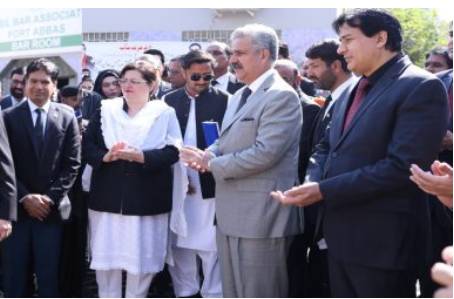
In the presence of the CJP and the Chief Justice of the Lahore High Court, the District and Sessions Judge Bahawalnagar inaugurated the newly established e-library and solarisation facility at the Judicial Complex. The initiatives are aimed at improving judicial research capacity and ensuring sustainable court operations in a climate-sensitive region. The CJP appreciated the Government of Punjab for executing the solarisation project within the stipulated timeline.
The District and Sessions Judge also performed the groundbreaking of a Women Bar Room and inaugurated an e-library for the Bar, marking a step toward creating a more inclusive and professionally enabling environment for women lawyers.
The CJP observed court proceedings of the Civil Judge and held detailed interactions with judges posted in Fort Abbas and adjoining areas. He acknowledged their dedication in administering justice under challenging conditions and assured institutional support to address issues such as human resource shortages, technological needs, and service delivery gaps.
He also appreciated existing litigant services and suggested establishing a public facilitation centre at the entrance of court premises, similar to the model at the Supreme Court, to provide essential services to litigants under one roof.
An interactive session with members of the Bar was also held, during which operational concerns were discussed and suggestions for procedural improvements were shared.
The CJP emphasized that constructive bench–bar cooperation and mutual respect are essential to maintaining public confidence in the justice system.
It was further announced that in fiscal year 2026–27, the reform agenda will move into a socially responsive phase with the establishment of dedicated Women Facilitation Centres within court complexes.
These centres will offer integrated services including free legal aid, psycho-social support, mediation and family visitation arrangements, gender-based violence victim support, and child protection services.
The CJP directed that infrastructural and service gaps be formally documented to ensure follow-up under the LJCP’s monitoring mechanisms.
The visit to Fort Abbas was described as part of broader efforts to translate constitutional ideals into tangible institutional progress, ensuring justice remains accessible and inclusive even in the country’s most remote judicial stations.