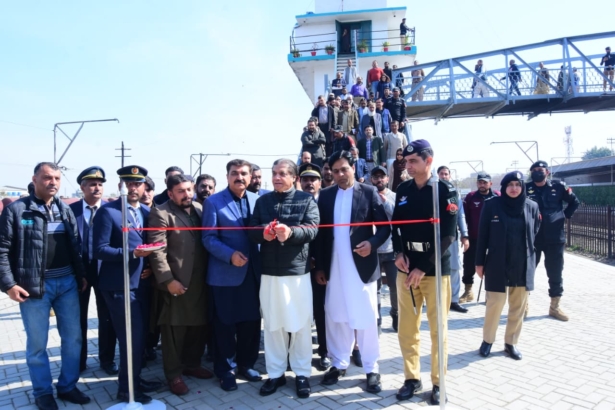

ISLAMABAD: Federal Minister for Railways Muhammad Hanif Abbasi on Saturday announced a wide-ranging reform and development agenda for Pakistan Railways, highlighting infrastructure upgrades, regional connectivity initiatives, digitalisation plans, and welfare measures for railway employees, while inaugurating the upgraded Platforms 4 and 5 at Rawalpindi Railway Station.
Speaking to the media, Abbasi said the deteriorated condition of railway tracks remains the biggest challenge for the sector but expressed confidence that the government will overcome these hurdles.
He said railway officers have been assigned specific targets to be completed by June 30, warning that officials failing to meet deadlines would not be allowed to continue in their positions.
He said Prime Minister Shehbaz Sharif has directed that there should be no negligence in improving Pakistan Railways, particularly in the rehabilitation of tracks, adding that the government is optimistic about achieving its set targets based on its performance so far.
Abbasi said Pakistan has signed agreements with Uzbekistan and Kazakhstan and is pursuing a proposed 840-kilometre rail corridor via Chaman, Kandahar, Herat and Turkmenistan, which would connect Pakistan with Central Asia.
He said such connectivity would open new trade routes and strengthen regional integration.
Referring to security challenges, the minister said Pakistan’s freight train operations near the Quetta–Taftan border with Iran had been targeted in attacks, delaying planned services. He said freight operations could have been launched earlier if security conditions had been stable.
He termed the resumption of the Jaffar Express and Bolan Express in Balochistan a major success and regretted that Pakistan had missed a critical opportunity to develop the ML-1 project in the past. However, he announced that a $2 billion Asian Development Bank approved project to upgrade the 480-kilometre Karachi–Rohri section would be launched by the end of July.
The minister announced that a “People’s Train” project will cover Quetta, funded by the Balochistan government, with new stations and locally manufactured coaches.
He said freight operations between Rohri and Karachi have increased from eight to ten daily trains, with a target of twelve services.
Abbasi said the government is prioritising the welfare of railway employees, including improvements in schools and hospitals, many of which are currently in poor condition.
He said hospitals will be outsourced to improve services and all major trains, including Hazara Express, will be upgraded by December this year.
He said Pakistan has started exporting railway coaches and wagons to Nepal, Bangladesh, Sri Lanka and Chile under government-to-government arrangements.
He added that the National Logistics Cell (NLC) plans to procure four trains from Pakistan Railways, while a $2.5 billion ML-II project will be developed with the support of NLC and DP World.
Abbasi said an agreement has been signed with the Frontier Works Organisation
(FWO) for digitalisation, and all railway stations will be transformed into smart and secure facilities. He also highlighted major development plans for Lahore Railway Station, with Rs2 billion allocated by Punjab Chief Minister Maryam Nawaz.
On safety, he said railway crossings remain a major issue, with 1,875 locations lacking gates, which falls under provincial jurisdiction.
He said safari trains have been launched to promote tourism, including in Thar, and similar initiatives will be pursued across the country.
Addressing political and legal matters, Abbasi said he would not mock anyone’s illness and that prisoners are entitled to medical treatment. However, he warned that illness should not be used as an excuse to seek remission of sentences and that jail rules would be followed strictly.