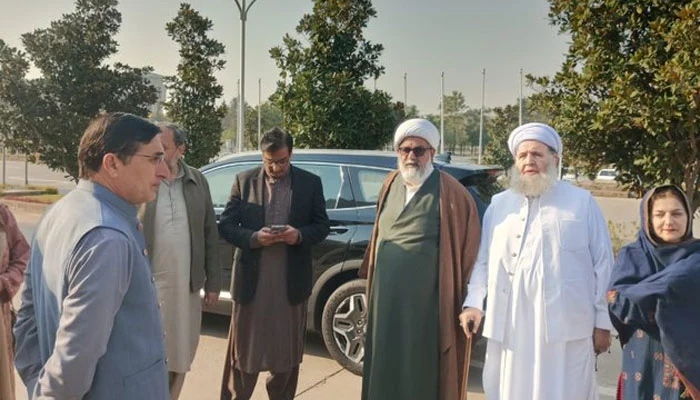

ISLAMABAD: The leader of the opposition alliance Tehreek Tahaffuz-e-Aiyeen Pakistan (TTAP), Allama Raja Nasir Abbas, on Wednesday announced ending the Parliament House sit-in staged over the health of the Pakistan Tehreek-e-Insaf (PTI) founder Imran Khan.
Speaking to journalists outside the Supreme Court, Allama Nasir Abbas said members of parliament had launched the protest solely over concerns about the PTI founder’s health and that the matter had also been taken to court.
The announcement comes shortly after consultations on the sit-in were held in the Supreme Court, where Khyber Pakhtunkhwa Chief Minister Sohail Afridi was also present.
Sources told Geo News said leadership of the opposition alliance continued consultations outside the Supreme Court following court proceedings, while discussions on the future course of the sit-in also remained underway after the hearings concluded.
Imran’s health has emerged as the latest point of contention between the government and the opposition comprising PTI and the TTAP alliance after a report, filed by his lawyer and SC’s amicus curiae Barrister Salman Safdar, revealed that the PTI founder was diagnosed with a serious eye condition known as central retinal vein occlusion (CRVO).
CRVO is a disorder that commonly affects older adults and is linked to underlying cardiovascular risk factors such as high blood pressure, high cholesterol, diabetes and heart disease.
Furthermore, the report stated that the former premier — who has been in jail since August 2023 — has complained of losing 85% of the vision in his right eye.
Following the medical report, lawmakers from the PTI and TTAP launched a multi-day sit-in at Parliament House and KP House in Islamabad on February 13, demanding that the PTI founder be shifted to a hospital for treatment of his eye condition.
The cricketer-turned-politician, 73, has been in jail since August 2023, convicted in a string of cases that he says were politically driven following his ouster in a 2022 parliamentary vote.
Meanwhile, Allama Nasir — while talking to media — said their central demand remained that the detained leader’s personal doctors be allowed to meet him.
He alleged that during the protest, parliament had effectively been turned into a “jail”, adding that when protesters attempted to leave the building, routes were blocked and several restrictions were imposed on participants inside the parliament precincts.
Allama Nasir said when reports emerged about the PTI founder’s eye condition, Mahmood Khan Achakzai had even proposed launching a hunger strike, prompting the alliance to intensify its protest to ensure that the PTI founder’s personal doctors were granted access.
Announcing the decision to wrap up the protest, the TTAP chief said the sit-in staged inside parliament was now being ended.
Furthermore, Allama Nasir said that the emotions of the PTI founder’s sisters were justified and that they should be allowed to meet him. He expressed hope that the PTI founder’s eye condition would improve, saying, “God willing, his eyes will be treated.”
He added that there was optimism regarding the improvement in his eyesight and demanded that the PTI founder be shifted to Shifa International Hospital for further treatment.
‘Street movement’
Separately, KP CM Afridi said that he had been assigned the responsibility of leading a “street movement” by the incarcerated PTI founder.
He alleged that court orders were being “thrown into the dustbin” and claimed that the PTI founder was still being denied access to his personal doctors.
Announcing the formation of a “PTI founder release force”, Afridi said the force would be formally registered and would pursue a peaceful struggle. He added that members of the force would take an oath in Peshawar immediately after Eid.
The chief minister said the force would have a clear chain of command and that the PTI founder would decide who would be given command responsibilities. He stressed that preparations would be completed before launching any struggle.
According to Afridi, the movement would be aimed at the supremacy of the Constitution, democracy, and an independent media.