
Everybody knows that galaxies are large structures made of stars. That’s a simple definition that ignores the fact that galaxies also contain gas, dust, planets, moons, comets, asteroids, etc., and, of course, dark matter.
But one type of galaxy is mostly made of dark matter, and they’re difficult to detect. They’re called dark galaxies, and they contain no stars, or only very few stars.
Scientists have long theorized about their existence, which has remained hypothetical; they’ve found galaxies with low surface brightness, and they’ve found dark galaxy candidates.
But new research has found the strongest candidate yet. The first author is Dayi (David) Li, a post-doctoral fellow in statistics and astrophysics at the University of Toronto.
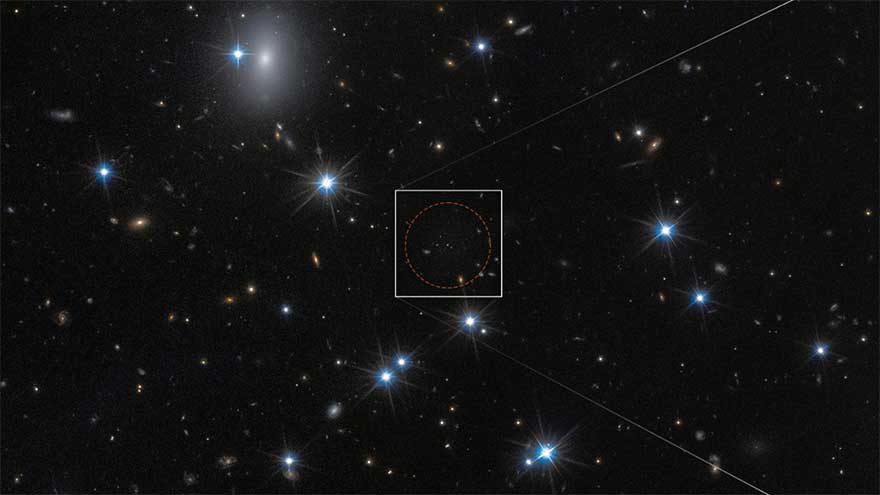
The candidate galaxy has been dubbed CDG-2, for Candidate Dark Galaxy 2. (CDG-1 is explained here.) CDG-2 is in the Perseus galaxy cluster about 300 million light-years away. The obvious question is, if it’s so dark, how was it detected?
It comes down to globular clusters (GC). Most galaxies have GCs. They’re spherical groups of stars that are bound together gravitationally and can contain millions of stars. Around spiral galaxies like ours, they’re mostly found in the galactic halo. Their origins are unclear, as is the role they play in the evolution of galaxies.
In this work, the researchers used the Hubble, the ESA’s Euclid space telescope, and Japan’s Subaru telescope. They searched for tight groupings of GCs that could indicate the presence of a galaxy. Hubble found four closely connected GCs in the Perseus cluster.
The researchers then applied advanced statistical methods to data from the three telescopes, revealing a faint glow around the GCs. This glow is a strong indication that there’s an underlying galaxy whose individual stars are too dim to resolve.
“This is the first galaxy detected solely through its globular cluster population,” lead author Li said in a press release. “Under conservative assumptions, the four clusters represent the entire globular cluster population of CDG-2.”