
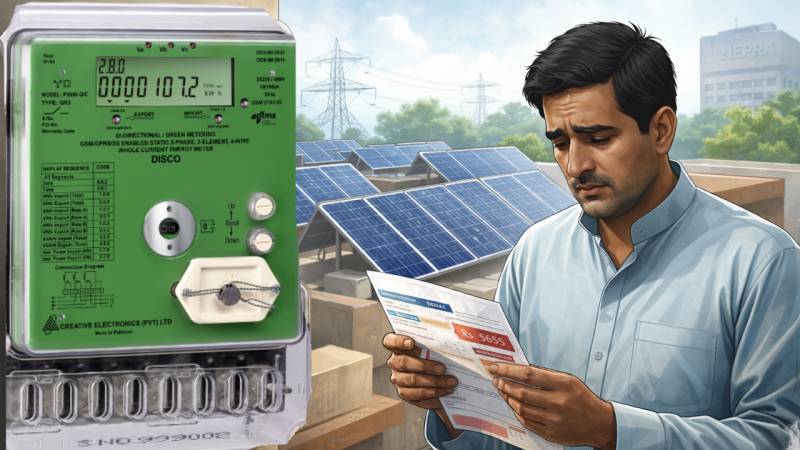

The federal government has imposed fixed charges on all consumers holding three-phase meters, including those with solar systems, with the new fees to be reflected in the current month’s electricity bills, it was reported on Wednesday.
According to the report, under the revised structure, consumers with three-phase meters and an approved load of five kilowatts will be required to pay a minimum fixed charge of Rs1,687 in addition to their regular electricity costs.
As per the details of the fixed charges, consumers will pay fees based on their sanctioned load.
Those with a six-kilowatt approved load will pay Rs2,025, seven kilowatts Rs2,362, eight kilowatts Rs2,700, nine kilowatts Rs3,037 and ten kilowatts Rs3,375.
Consumers with eleven kilowatts will pay Rs3,712, twelve kilowatts Rs4,050, thirteen kilowatts Rs4,387, fourteen kilowatts Rs4,725, and fifteen kilowatts Rs5,062 in fixed charges.
The report states that for approved loads exceeding fifteen kilowatts, fixed charges will increase further.

The imposition of fixed charges is expected to significantly affect consumers who have installed solar systems, as well as residents of private housing societies who rely on three-phase connections.
The charges have been implemented following approval from the National Electric Power Regulatory Authority (NEPRA) and will be applied in the current billing cycle.
Last month, on February 16, NEPRA announced that it would retain the existing net metering policy for current solar consumers.
In this regard, Nepra issued a notification on proposed amendments and invited public feedback within 30 days. The updated framework is set to take effect on February 9, 2026.
Under the revised regulations, surplus electricity generated by new solar consumers will be purchased at Rs11 per unit. The duration of agreements for new consumers has also been reduced from seven years to five years.
While existing registered solar users will continue under the current net metering regime, significant changes have been introduced for new entrants. Last week, Nepra issued a notification replacing the net metering policy with a net billing system.
The authority also introduced the “Solar Consumers Regulations 2026″, outlining the updated framework for distributed generation. The revised structure removes the unit-for-unit adjustment mechanism, which previously allowed consumers to offset exported electricity directly against their consumption.