
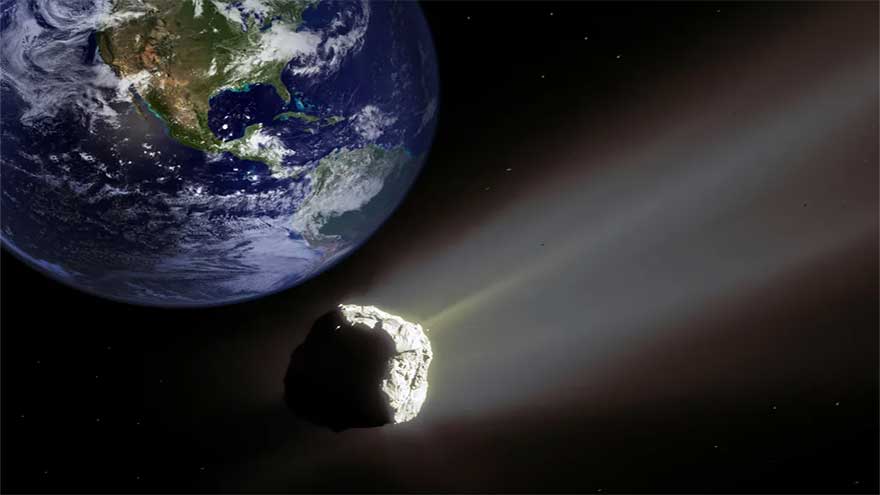

NASA has revealed the results of a fresh probe into a “city killer” asteroid that scientists predicted would crash into the Moon.
Originally, it was thought that asteroid 2024 YR4 may even smash into Earth – but that was later ruled out.
The 220ft asteroid was first discovered in late 2024, and at one point had a 3.1% chance of crashing into Earth.
But after collecting data, astronomers were able to reduce these odds to zero.
However, there was still a 4.3% chance that it might collide with the Moon in a 38,000mph impact.
Now Nasa says that there’s zero chance of that happening either.
Astronomers have scooped up two fresh sets of data (from February 18 and 26) using the James Webb Space Telescope.
And this has “refined” the odds of the asteroid having a massive collision with the Moon.
Nasa says that its Jet Propulsion Laboratory is officially “ruling out a chance of lunar impact”.
The collision was originally predicted to take place on December 22, 2032.
But now, it’s believed that the asteroid will soar past the lunar surface at a distance of 13,200 miles.
“This update reflects improved precision in our understanding of where the asteroid is expected to be in 2032 rather than a shift in its orbital path,” Nasa’s Molly Wasser explained.
“Previous analyses, made before the incorporation of these new observations, suggested 2024 YR4 had a 4.3% chance of lunar impact on this date.”
She added: “Since spring of 2025, the asteroid has been unobservable from both Earth and space-based observatories except for this use of Webb to make among the faintest ever observations of an asteroid.”
The asteroid itself is fairly large, with a diameter of somewhere between 174 and 220 feet.
That’s about the same length of six or seven London double-decker buses.
An asteroid of this size is big enough to annihilate a city, which means it ranks alongside other “city killer” space rocks.
Thankfully, there’s no risk that it’ll hit Earth or the Moon in 2032.
It actually passed close to Earth on Christmas Day in 2024, swinging by at a distance of 515,000 miles.
And it’s expected to make another close approach on December 17, 2028 – again, without incident.