

KARACHI: The Pakistan Stock Exchange (PSX) continued its downward trend on Monday, with the KSE-100 index dropping more than 11,000 points at the start of the new trading week, as investors pulled funds in response to escalating tensions in the Middle East and fears of increase in policy rate.
The benchmark index shed massive 11,015.96 points to reach 146,480.14 points, reflecting a negative change of 6.99 percent compared to previous close of 157.496 points.
Earlier, trading activity was suspended at the stock market after it recorded a decline of over 10,000 points.
A total of 621,653,341 shares were traded during the day as compared to 363,145,903 shares the previous trading day, whereas the price of shares stood at Rs 37.116 billion against Rs 23.108 billion on the last trading day.
As many as 480 companies transacted their shares in the stock market, 33 of them recorded gains and 386 sustained losses, whereas the share price of 61 companies remained unchanged. The three top trading companies were K-Electric Ltd. with 127,469,387 shares at Rs 7.20 per share, F. Nat. Equities with 33,608,420 shares at Rs 1.15 per share and Bank of Punjab with 33,386,862 shares at Rs 25.45 per share.
Blessed Textiles Limited witnessed a maximum increase of Rs 32.43 per share price, closing at Rs 356.72, whereas Faisal Spinning Mills Limited was the runner-up with a Rs 25.11 rise in its per share price to Rs 290.71. Unilever Pakistan Foods Limited witnessed a maximum decrease of Rs 1,371.42 per share, closing at Rs 23,698.33, followed by Sazgar Engineering Works Limited with a Rs 213.22 decline to close at Rs 1,918.97. In the futures market, 316 companies recorded trading, of which one increased whereas 315 decreased.
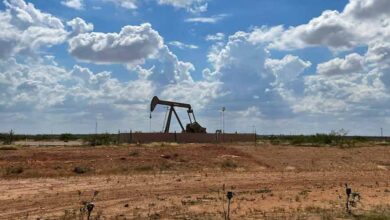
On the other hand, Oil prices surged about 20% on Monday, hitting their highest since July 2022, as the expanding U.S.-Israeli war with Iran led some major Middle Eastern oil producers to cut supplies and on fears of prolonged disruption to shipping through the Strait of Hormuz chokepoint.
Iraq and Kuwait have begun cutting oil output, adding to earlier liquefied natural gas reductions from Qatar, as the war blocked shipments from the Middle East.
Analysts predict the United Arab Emirates and Saudi Arabia will have to also cut output soon as they run out of oil storage.
The war could leave consumers and businesses worldwide facing weeks or months of higher fuel prices even if the week-old conflict ends quickly, as suppliers grapple with damaged facilities, disrupted logistics and elevated risks to shipping.
Brent crude futures rose as much as $18.35, or 19.8%, to $111.04 a barrel and were up $15.24, or 16.4%, at $107.93 as of 0014 GMT on Monday.
U.S. West Texas Intermediate (WTI) crude futures were up $16.50, or 18.2%, at $107.40 a barrel, after rising as much as $20.34, or 22.4%, to $111.24 earlier in the session.
Brent climbed 27% and WTI rose 35.6% last week, before the latest jumps.