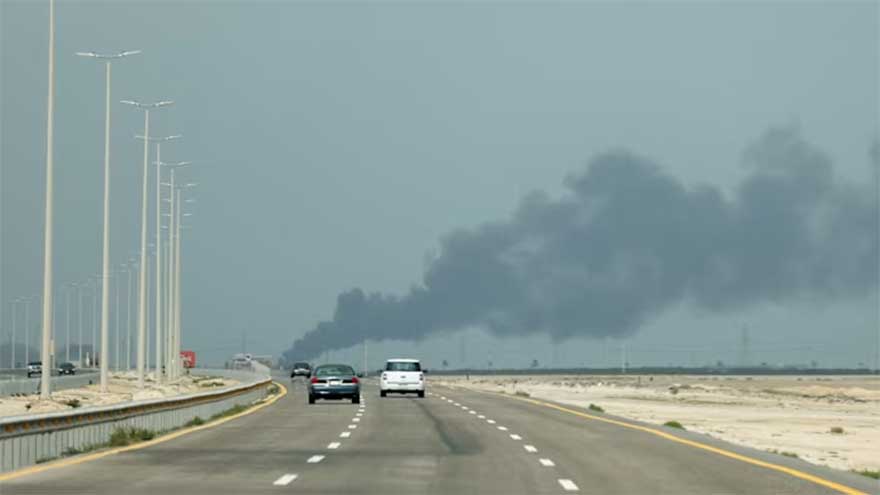

Gulf oil producers have faced a staggering $15.1 billion loss in energy revenues since the escalation of US and Israeli strikes on Iran, as millions of barrels of crude oil have become stranded due to the near-shutdown of the Strait of Hormuz, according to the Financial Times.
Commodity analytics firm Kpler estimates that the Strait typically handles about $1.2 billion worth of crude oil, refined products, and liquefied natural gas (LNG) each day, based on 2025’s average prices and volumes.
The situation worsened after the conflict intensified on February 28, with shipping traffic through this vital passageway grinding to a halt. Iran’s attacks on vessels and surging insurance premiums have compounded the crisis.
This loss in revenue highlights the significant financial toll the war has taken on Gulf states, whose economies heavily depend on commodity exports to sustain their governments.
Florian Gruenberger from Kpler noted that traffic through the Strait is now “negligible” compared to pre-war levels. Among the stranded shipments, crude oil accounted for the largest portion, making up 71% of the total value.
As the largest oil exporter, Saudi Arabia has been the most affected, with an estimated $4.5 billion in lost revenues since the conflict’s start, according to Wood Mackenzie. However, the kingdom plans to increase exports from the Red Sea in the coming days to mitigate the damage.
Peter Martin, head of economics at Wood Mackenzie, emphasized that Iraq, which relies on oil for 90% of its government revenue, is among the most vulnerable. Kuwait and Qatar also face high risks, but their substantial sovereign wealth funds can provide a cushion against short-term losses.
Kpler reported that at least $10.7 billion worth of crude, refined oil products, and LNG cargoes remain stuck in the Strait of Hormuz, unable to reach their intended destinations. Some of these shipments were already sold under long-term contracts, which may still generate revenue, depending on the payment cycle, typically between 15 and 30 days after loading.
The disruption’s impact is expected to vary by producer. Antoine Halff, co-founder of satellite analytics company Kayrros, noted that Saudi Arabia might be in a better position to handle the disruption than Iraq, which faces more significant losses.
Saudi Arabia holds oil in overseas storage, allowing it to continue supplying customers temporarily. The kingdom could also benefit from higher prices, which might help offset the lost export revenue. However, Halff cautioned that consumers, particularly motorists, will likely experience the worst effects of rising prices.
Although Saudi Aramco has stated it could reroute 70% of its crude shipments from its eastern oilfields to the Red Sea through the East-West pipeline, analysts warn that the pipeline has never operated at this capacity.
Wood Mackenzie further estimates that Gulf oil producers — including Saudi Arabia, Iraq, the UAE, Kuwait, and Bahrain — have collectively deferred $13.3 billion in sales and tax revenues from oil exports.
Meanwhile, QatarEnergy, Qatar’s state-owned energy company, has lost about $571 million in revenue as of Wednesday, after halting production on March 2. This figure excludes any potential losses tied to delays in planned expansions or new plants.