
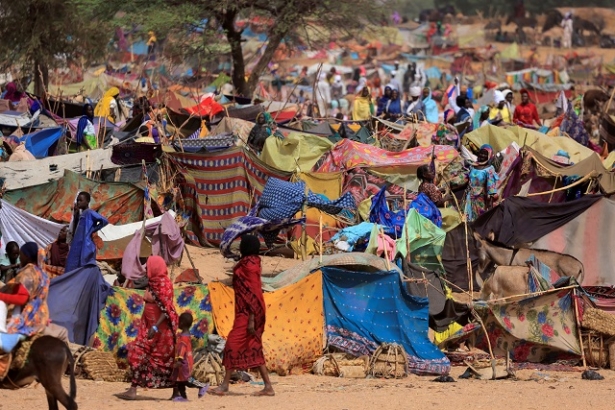

Millions of people in Sudan are surviving on just one meal a day as the country’s food crisis worsens, according to a report released by several international aid groups. The findings highlight the devastating impact of Sudan’s war, which enters its third year this week, and underline the scale of one of the world’s largest humanitarian emergencies.
The conflict between the Sudanese army and the paramilitary Rapid Support Forces has displaced millions and disrupted farming, trade, and access to food. In the hardest-hit regions of North Darfur and South Kordofan, families often go entire days without eating. The report, compiled by Action Against Hunger, CARE International, International Rescue Committee, Mercy Corps, and the Norwegian Refugee Council, describes how many people have resorted to consuming leaves and animal feed to survive.
Sudan’s government, aligned with the army, denies famine exists, while the RSF rejects responsibility for conditions in areas under its control. Yet humanitarian data paints a grim picture. The 2026 Humanitarian Needs and Response Plan estimates that 28.9 million people, or 61.7 percent of Sudan’s population, are acutely food-insecure.
The United Nations has documented widespread atrocities and ethnically charged violence. In November, global hunger monitors confirmed famine conditions in al-Fashir and Kadugli. By February, the U.N.-backed Integrated Food Security Phase Classification reported that famine thresholds for acute malnutrition had been surpassed in Um Baru and Kernoi, where rates of malnourished children under five nearly doubled the famine threshold.
The report details how the war has driven communities toward famine through deliberate destruction of farms and markets. Aid groups say starvation is being used as a weapon of war. Communal kitchens, once a lifeline for displaced families, are increasingly unable to meet demand. At the same time, donor funding cuts have severely limited the ability of humanitarian agencies to respond.
Women and girls face disproportionate risks in this crisis. The report notes that they are vulnerable to rape and harassment when traveling to fields, markets, or water sources. Female-headed households are three times more likely to experience food insecurity compared to male-headed households.
Farmers and traders interviewed for the report described how violence has disrupted planting and harvesting cycles, leaving communities without reliable food supplies. Humanitarian actors warned that without immediate intervention, famine conditions could spread further across the country.
Despite mounting evidence, Sudan’s government continues to deny famine exists. Aid groups argue that acknowledging the crisis is essential to mobilize international support and resources. The RSF, meanwhile, distances itself from responsibility, even as conditions in areas under its control deteriorate.
The worsening food crisis in Sudan illustrates how conflict and political instability can devastate civilian populations. With millions surviving on one meal a day, the humanitarian emergency has reached a critical point. Aid organizations stress that without urgent action, the situation will spiral further, leaving even more families at risk of starvation.