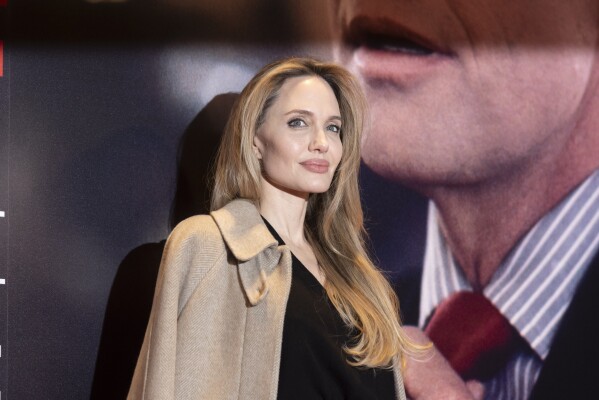

Maria” seems assured of bringing Jolie her third Oscar nomination. (She won supporting actress in 2000 for “Girl, Interrupted.”) For an actress whose filmography might lack a signature movie, “Maria” may be Jolie’s defining role.
Jolie’s oldest children, Maddox and Pax, worked on the set of the film. There, they saw a version of their mother they hadn’t seen before.
“They had certainly seen me sad in my life. But I don’t cry in front of my children like that,” Jolie says of the emotion Callas dredged up in her. “That was a moment in realizing they were going to be with me, side by side, in this process of really understanding the depth of some of the pain I carry.”
Jolie, who met a reporter earlier this fall at the Carlyle Hotel, didn’t speak in any detail of that pain. But it was hard not to sense some it had to do with her lengthy and ongoing divorce from Brad Pitt, with whom she had six children.
Just prior to meeting, a judge allowed Pitt’s remaining claim against Jolie, over the French winery Château Miraval, to proceed. On Monday, a judge ruled that Pitt must disclose documents Jolie’s legal team have sought that they allege include “communications concerning abuse.” Pitt has denied ever being abusive.
The result of the U.S. presidential election was also just days old, though Jolie — special envoy for the United Nations Refugee Agency from 2012 to 2022 – wasn’t inclined to talk politics. Asked about Donald Trump’s win, she responded, “Global storytelling is essential,” before adding: “That’s what I’m focusing on. Listening. Listening to the voices of people in my country and around the world.”
Balancing such things — reports concerning her private life, questions that accompany someone of her fame — is a big reason why Jolie is so suited to the part of Callas. The film takes place during the American-born soprano’s final days. (She died of a heart attack at 53 in 1977.) Spending much of her time in her grand Paris apartment, Callas hasn’t sung publicly in years; she’s lost her voice. Imprisoned by the myth she’s created, Callas is redefining herself and her voice. An instructor tells her he wants to hear “Callas, not Maria.” The movie, of course, is more concerned with Maria.
It’s Larrain’s third portrait of 20th century female icon, following “Jackie” (with Natalie Portman as Jacqueline Kennedy) and “Spencer” (with Kristen Stewart as Princess Diana). As Callas, Jolie is wonderfully regal — a self-possessed diva who deliciously, in lines penned by screenwriter Steven Knight, spouts lines like: “I took liberties all my life and the world took liberties with me.”
Asked if she identified with that line, Jolie answered, “Yeah, yeah.” Then she took a long pause.
“I’m sure people will read a lot into this and there’s probably a lot I could say but don’t want to feed into,” Jolie eventually continues. “I know she was a public person because she loved her work. And I’m a public person because I love my work, not because I like being public. I think some people are more comfortable with a public life, and I’ve never been fully comfortable with it.”
When Larraín first approached Jolie about the role, he screened “Spencer” for her. That film, like “Jackie” and “Maria,” eschews a biopic approach to instead intimately focus on a specific moment of crisis. Larraín was convinced Jolie was meant for the role.