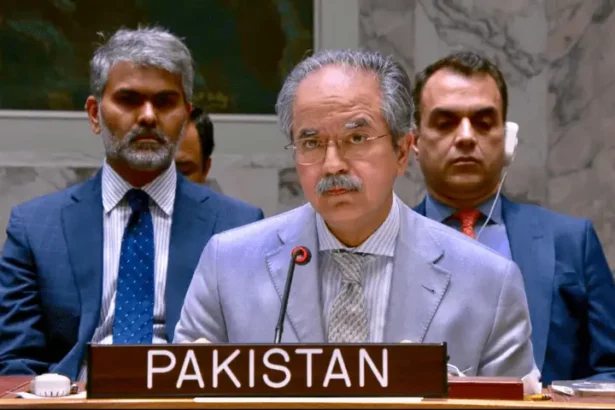

Pakistan has intensified its call for stronger adherence to international law and meaningful reform of the United Nations Security Council at a time of rising global instability.
Speaking at the International Law Year in Review 2026 Conference, Pakistan’s Permanent Representative to the United Nations, Ambassador Asim Iftikhar Ahmad, warned that selective compliance with international treaties is weakening the foundations of the global order. He said the principles of the UN Charter must be applied equally and consistently to all states.
The ambassador stressed that legal exceptionalism is undermining trust in multilateral institutions. He cautioned that ignoring binding agreements threatens the collective security system created after World War II.
Ambassador Asim highlighted growing divisions among major powers within the Security Council. He said these divisions have increasingly paralysed the body and reduced its ability to respond effectively to international crises.
Referring to Pakistan’s presidency of the Security Council last year, he cited the unanimous adoption of Resolution 2788 as proof that consensus is still possible. He said the resolution reaffirmed the importance of resolving disputes through peaceful means, despite deep geopolitical rivalries.
He also raised concerns over actions that disregard established international agreements. Referring to India’s unilateral decision to place the Indus Waters Treaty in abeyance, the ambassador said such steps weaken confidence in international law and pose risks to regional stability.
On the issue of Security Council reform, Pakistan reiterated its opposition to proposals that would expand permanent membership or preserve veto privileges. Ambassador Asim said such models would only deepen existing inequalities within the Council. He argued that reform should strengthen the role of elected members to better reflect the collective voice of the wider UN membership.
The ambassador also drew attention to emerging global challenges. He said the UN must play a central role in developing legal frameworks for artificial intelligence, cyber operations, and autonomous weapons. Without regulation, he warned, these technologies could become new sources of conflict.
While acknowledging criticism of the UN’s effectiveness, Ambassador Asim said the organisation still enjoys broad legitimacy among most member states. He stressed that global confidence in multilateralism remains strong and that reform, not marginalisation, is the solution.
Diplomatic discussions at the UN have also reflected concerns about the rise of parallel international initiatives operating outside established UN mechanisms. Several delegations have privately warned that such arrangements could undermine existing processes if not properly aligned.
Earlier this week, Pakistan joined a group of countries in endorsing the charter of a proposed “Board of Peace,” an initiative led by US President Donald Trump. Although the initiative has been described as complementary to the UN, diplomats cautioned that it could complicate international peace efforts if it operates independently.