
Muhammad Yunus stepped down as Bangladesh’s interim government chief on Monday evening and triggered renewed unease in India through remarks. In his farewell address, Yunus portrayed Bangladesh’s sea as a global trade gateway and emphasized strong regional economic potential.
He stated that Nepal, Bhutan, and the Seven Sisters offer vast economic opportunities within the evolving regional landscape.
Who are seven sisters?
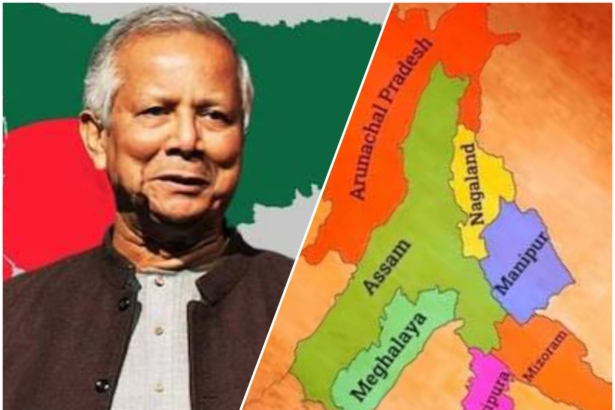
The Seven Sisters comprise Arunachal Pradesh, Assam, Manipur, Meghalaya, Mizoram, Nagaland, and Tripura in India’s northeast region.
Yunus cited the Seven Sisters without mentioning India directly, prompting interpretations that he views them distinctly.
Analysts observed that he has previously framed the northeastern states in similar strategic language. During a four day March visit to China, Yunus again highlighted the Seven Sisters’ geographic position. He argued that these states lack sea access and described Bangladesh as the area’s maritime guardian.
Yunus added that the landlocked region presents major manufacturing and export opportunities for China’s expanding economy.
Assam Chief Minister Himanta Biswa Sarma strongly criticized the statement and labeled it objectionable and strategically provocative. He asserted that presenting Bangladesh as the sole maritime outlet suggests deeper long term geopolitical intentions.
The Siliguri Corridor heightens regional sensitivity because it links northeastern India with the national mainland.
This narrow passage measures roughly twenty two kilometers and carries the strategic nickname Chicken’s Neck.
Bangladesh and Nepal flank the corridor, while Bhutan and China stand only short distances away.
Geographically, the Seven Sisters sit encircled by Bangladesh, Bhutan, China, and Myanmar without direct ocean access. They maintain land connectivity with mainland India exclusively through the Siliguri Corridor route.
China claims Arunachal Pradesh as South Tibet and has renamed multiple locations inside the territory.
India dismissed those renamings and reaffirmed that symbolic changes cannot alter established sovereignty facts.
Sanjeev Sanyal questioned Yunus’s comments and challenged their relevance to China’s investment interests.
Bangladeshi student leaders also issued controversial remarks concerning India’s northeastern states.
A National Citizen Party figure warned that instability in Bangladesh could impact India’s northeastern cohesion.
A retired Bangladeshi general proposed cooperation with China after a hypothetical India Pakistan escalation, but authorities distanced themselves.
Bangladesh shares ninety four percent of its 4,367 kilometer border with India.
Bangladesh relies on India for trade and security, while India seeks transit for northeastern access.
Social media discussions last April claimed Bangladesh revived Lalmonirhat airbase with reported Chinese cooperation.
The facility stands near India’s border and within proximity of the sensitive Siliguri Corridor.
India and Bangladesh consistently negotiate transit corridors linking northeastern states through Bangladeshi territory.
Former ambassador Sirajul Islam wrote that India seeks Chattogram Port access for northeastern commerce.
He traced the debate to the 1972 bilateral trade agreement permitting mutual transport facilities.
Islam described the transit matter as sensitive and highlighted consistent domestic opposition inside Bangladesh.
He explained that geography and historical distrust fuel concerns about potential Indian dominance.
Islam argued that transit arrangements could boost revenue and strengthen Bangladesh’s bargaining leverage.
He suggested economic integration would encourage regional trust, cooperation, and shared development goals. Islam concluded that Bangladesh could later review transit decisions instead of committing permanently.