
A senior United States official has disclosed new technical details regarding an alleged underground nuclear test conducted by China in June 2020, intensifying tensions over global arms control.
Speaking at the Hudson Institute in Washington, Assistant Secretary of State Christopher Yeaw said fresh analysis of seismic data suggests a controlled underground explosion took place at China’s Lop Nor nuclear test site on June 22, 2020.
According to Yeaw, a remote seismic monitoring station in Kazakhstan detected a magnitude 2.75 event approximately 720 kilometers from the Lop Nur facility in western China. He argued the seismic signature was inconsistent with mining activity or natural earthquakes.
“There is very little possibility that it was anything other than an explosion,” Yeaw said, adding that the characteristics matched what would be expected from a nuclear explosive test.
However, the Comprehensive Nuclear-Test-Ban Treaty Organization (CTBTO), which oversees a global monitoring network for nuclear explosions, stated that the available data is insufficient to conclusively determine the nature of the seismic activity.
CTBTO Executive Secretary Robert Floyd said its PS23 monitoring station in Kazakhstan recorded two minor seismic events just 12 seconds apart on the same day. He noted that the signals were well below the threshold typically associated with detectable nuclear test explosions.
“With the data alone, it is not possible to assess the cause of these events with confidence,” Floyd said in a statement.
Yeaw further alleged that China may have attempted to mask the explosion using a technique known as “decoupling,” where a device is detonated inside a large underground cavity to dampen shockwaves and reduce seismic detection.
China has strongly denied conducting any nuclear test. Beijing maintains that it complies with the 1996 Comprehensive Nuclear-Test-Ban Treaty, which it has signed but not formally ratified. China’s last acknowledged underground nuclear test occurred in 1996.
Like China, the United States has also signed but not ratified the treaty. Washington last carried out an underground nuclear test in 1992 and now relies on advanced simulations and scientific assessments to maintain its nuclear arsenal.
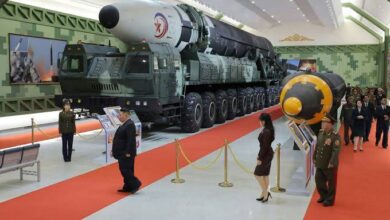
The renewed allegations come amid growing concerns about a potential global nuclear arms race following the expiration of New START, the last major arms control agreement between the United States and Russia. Former US President Donald Trump had previously urged China to join trilateral arms control negotiations, a proposal Beijing rejected, arguing its nuclear stockpile remains significantly smaller than those of Washington and Moscow.
According to the Pentagon, China currently possesses more than 600 operational nuclear warheads and is rapidly expanding its strategic forces. US defense projections estimate that Beijing’s arsenal could exceed 1,000 warheads by 2030.