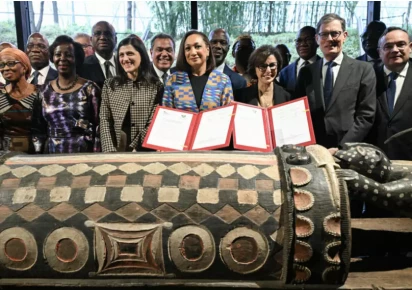

In a move that was both ceremonial and symbolic, France on Friday repatriated a colonial-era “talking drum” to Ivory Coast, marking the latest move by Europe to send back looted African artifacts. The Djidji Ayokwe drum, which stands over three meters tall and weighs a whopping 430 kilos, was seized by French colonial troops in 1916.
The drum, which was a landmark of the Ebrie people, was used to communicate messages over long distances, a vital tool for communication in pre-modern Ivory Coast. The drum is set to be displayed in a brand-new museum currently under construction in Abidjan, the commercial capital of Ivory Coast.
“Ivory Coast is ready to receive it with open arms,” Ivory Coast Culture Minister Françoise Remarck said at the ceremony in Paris, where she stood alongside French Culture Minister Rachida Dati. Remarck described the moment as “deeply emotional,” saying that the drum represented a symbol of heritage finally coming home.
The drum, which was a vital tool for communication in pre-modern Ivory Coast, is set to be displayed in a brand-new museum currently under construction in Abidjan, Ivory Coast’s commercial capital.

Today, the museums in France house tens of thousands of artworks and artifacts collected during the colonial period, many of which have been the subject of restitution claims from countries such as Algeria, Mali, and Benin for decades. While Western museums have been loath to return plundered artifacts, recent developments indicate a new willingness to come to terms with their colonial pasts through cultural diplomacy.
The return of a prized artifact such as the Djidji Ayokwe drum is seen as highly significant, reflecting the role of cultural heritage in bridging past and present in international relations.
With the new legislation in place, France hopes to expedite the return of hundreds of artifacts, representing one of the largest mass repatriations in recent history. While African countries wait for the return of their beloved artifacts, the drum’s return home highlights a larger effort to reclaim cultural heritage and overcome the scars of colonial history.
The Paris ceremony represented more than the return of a historical drum to its country of origin; it represented a gesture towards a more just and progressive cultural future, reflecting France’s changing attitude towards its colonial history and its responsibilities to the countries it once colonized.