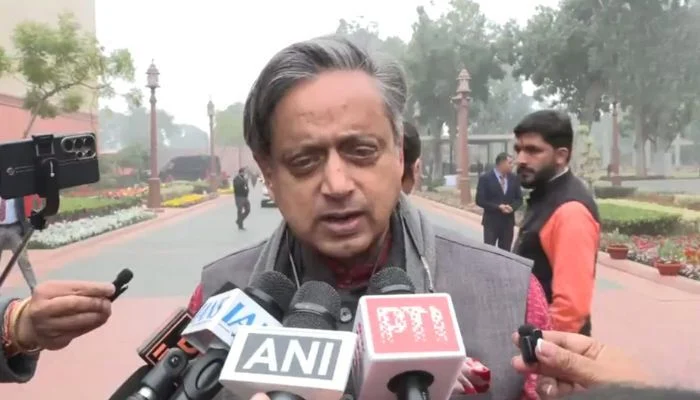

In a recent Indian Express column (February 5), Congress leader Shashi Tharoor, who chairs the Lok Sabha’s Foreign Relations Committee, made a case for dialogue between India and Pakistan, stating that “peace is not weakness and dialogue is not defeat”.
Tharoor’s intervention comes at a moment when hostility between the two neighbours has calcified into official dogma. Tharoor’s perspective stands out as more thoughtful and forward-looking than much of New Delhi’s current discourse, rightly observing that permanent disengagement is neither practical nor sustainable. Still, the way dialogue is publicly framed often places a lopsided burden of responsibility, subtly undermining the very peace it aims to promote.
Few would disagree that the last 30 years of India-Pakistan relations have fallen into a dispiriting cycle: cautious diplomatic overtures are repeatedly shattered by acts of terrorism. Tragedies like Mumbai (2008), Pathankot (2016) and Pulwama (2019) brought pain to countless families and derailed any hope of sustained engagement. Pakistan acknowledges the gravity of these attacks and accepts the validity of India’s insistence that terrorism cannot become an accepted feature of bilateral relations.
Yet, there remain episodes – like the Chatisinghpura massacre (2000), Pulwama (2019) and Pahalgam (2025) – whose facts are still contested. More fundamentally, India has not earnestly engaged in dialogue over the core issue of Kashmir; it has repeatedly conflated the Kashmiri people’s aspirations with terrorism. This move has too often served as a convenient excuse to sideline the legitimate demand for self-determination in the region.
Similarly, viewing the entire relationship through the narrow prism of “Indian outreach undermined by Pakistani terrorism” flattens a far more intricate reality. Pakistan, too, has borne the brunt of relentless terrorist violence – losing some 80,000 civilians and security personnel in just two decades. The toll on national stability, growth and societal trust has been immense.
In response, Pakistan has launched extensive counterterrorism campaigns, enacted legal reforms and tightened financial oversight, measures that have measurably weakened violent networks. To disregard these hard-won gains is to trap the conversation in the past and sap motivation for further progress.
India’s refrain that “dialogue without accountability amounts to self-deception” certainly finds traction at home. But accountability is a two-way street. Trust can be eroded by non-state violence or by sweeping political decisions that alter fragile realities. From Islamabad’s vantage, India’s revocation of Jammu and Kashmir’s special constitutional status in August 2019 – carried out under lockdown, mass arrests and a communications blackout – was not a mere administrative act, but a stark signal of hardened resolve. Meanwhile, incidents like the arrest of Kalbhushan Yadev and Indian support for BLA and TTP terrorists have deepened Pakistani scepticism toward Indian overtures. Any realistic dialogue must confront the corrosive effects of both unilateralism and violence.
Tharoor is at his most persuasive when he challenges the idea that silence somehow ensures stability. In a region bristling with nuclear arms and threadbare crisis-management tools, the risks of miscalculation only grow when lines of communication go quiet. Whether it’s diplomatic backchannels, military hotlines or informal contacts, these mechanisms exist not to reward cooperation but to avert catastrophe. Pakistani analysts, for their part, have consistently argued that dialogue is not a privilege, but a lifeline, especially in times of acute tension.
Tharoor’s call to move away from high-stakes summits in favour of a more layered, everyday engagement is not just wise, it’s overdue. History shows that headline-grabbing meetings are fragile, easily derailed by a single incident. In contrast, regular, lower-level contact – among diplomats, military officers, technical experts and ordinary citizens – offers a sturdier foundation. Whether it’s students crossing borders for study, families seeking medical care, or traders and pilgrims finding new routes, these connections can help steady relations even as politics lurches from crisis to crisis.
For decades, voices for peace have persevered on both sides of the border. In Pakistan, journalists, scholars, business leaders and civil society groups have stubbornly championed engagement, even when the political climate has been downright hostile. In India, those who speak up for dialogue now face increasing isolation. The real problem isn’t a lack of peace advocates; it’s the political calculus in both countries that rewards confrontation over compromise. The current order in New Delhi, dominated by the RSS, has only further marginalised those pushing for a different path.
Ironically, people-to-people ties have frequently been casualties of political decision-making rather than security failures. Sporting exchanges, cultural visits and even humanitarian access have been repeatedly suspended, sometimes during periods of relative calm. A serious effort would be required to insulate from episodic crises and be treated as a confidence-building asset rather than an expendable bargaining chip.
Incremental measures based on benchmarks and reciprocity offer a pragmatic alternative to binary ‘talk or don’t talk’ approaches. But such benchmarks must be realistic, and reciprocity credible. Progress, however limited, must be acknowledged if momentum is to be sustained.
Equally important for both countries is recognising that restraint is a shared responsibility. India, as the larger power, bears a proportionate obligation to manage escalation risks. Strategic confidence is not demonstrated through indefinite disengagement, but through shaping engagement in ways that safeguard security while reducing the likelihood of conflict. Dialogue does not weaken a counterterrorism posture; it strengthens crisis management and clarifies thresholds. India must realise that its bland accusation of terrorism against Pakistan only highlights its callousness towards Pakistan’s sufferings at the hands of terrorism during the past 47 years, ever since the Soviet invasion of Afghanistan.
Tharoor’s brief reference to functional cooperation deserves greater attention. Climate change, water stress, disaster response and public health challenges transcend borders. Mechanisms such as Indus waters management, environmental coordination, and disaster relief provide depoliticised platforms where cooperation is not a concession but a necessity. Preserving and strengthening these regimes is essential as environmental pressures intensify across South Asia.
India-Pakistan relations are unlikely to become frictionless. Historical grievances and institutional mistrust run deep. Yet permanent disengagement is not realism; it is resignation. Dialogue cannot be held hostage to the absence of spoilers. It must be sustained precisely because spoilers exist.
As rightly put by Shashi Tharoor, “peace is not weakness, and dialogue is not defeat”. But dialogue that endures must rest on mutual recognition despite festering disputes – that security concerns are legitimate on both sides, that responsibility is shared and that stability cannot be imposed unilaterally. Both need engagement beyond symbolism towards substance and from merely postponing conflict to preventing it.