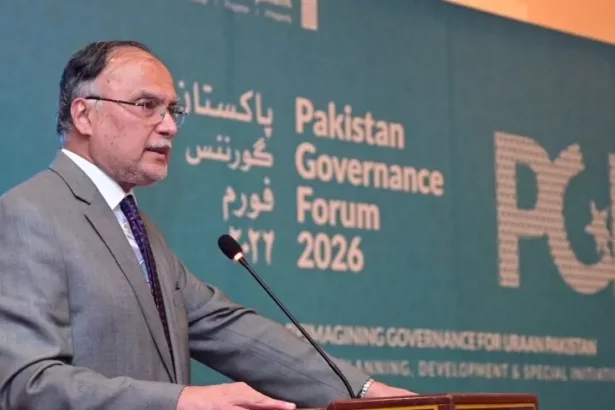

Federal Minister for Planning, Development, and Special Initiatives, Ahsan Iqbal, has proposed major reforms to the National Finance Commission (NFC) Award. He emphasized the need for changes that promote poverty reduction, population stabilization, human development, and environmental sustainability. He made these remarks at the Pakistan Governance Forum 2026 in Islamabad.
Iqbal highlighted that the federal government faces significant fiscal pressures. He said federal tax revenue stands at roughly Rs14 trillion, with Rs5 trillion from non-tax sources. Around Rs8.2 trillion is transferred to provinces under the NFC Award. After these allocations, the federal government retains only Rs11.07 trillion against total expenditures of nearly Rs17.5 trillion.
The minister noted that almost half of federal spending goes toward debt servicing. About 25% is used for defense. He added that pensions, salaries, development projects, and social protection programs must also be funded. “This system is not sustainable,” he said.
Despite social welfare being largely a provincial responsibility after the 18th Amendment, the federal government continues to fund major programs. The Benazir Income Support Programme (BISP) alone costs around Rs716 billion annually. The federal government also finances Azad Kashmir, Gilgit-Baltistan, and Islamabad Capital Territory (ICT).
Iqbal also called for changes in the NFC formula. Currently, 82% of the allocation is based on population. This discourages provinces from pursuing population control measures. Only 10% of the formula is linked to poverty reduction, which may inadvertently benefit provinces that remain poor. He suggested revising the formula to reward provinces for reducing poverty, improving human development, promoting climate resilience, and encouraging population stabilization.
Punjab Minister Marriyum Aurangzeb joined via video link from Lahore. She said the NFC must function as a true partnership between the federal government and provinces. She emphasized fairness, transparency, and cooperation in fiscal matters.
Aurangzeb highlighted that future reforms must consider debt servicing, defense spending, climate risks, and water security. She added that expanding the tax base, increasing the tax-to-GDP ratio, generating provincial revenue, and promoting economic growth are essential for long-term fiscal stability.
The forum focused on ensuring that the NFC framework supports development and sustainability. Officials stressed the importance of incentives that encourage provinces to reduce poverty and manage population growth. The proposed reforms aim to create a more balanced, fair, and forward-looking financial system in Pakistan.
Fiscal experts and policymakers at the event said that without such reforms, the federal government’s ability to fund essential programs could be severely constrained. They also highlighted the need for stronger cooperation between the federation and provinces to address economic challenges and social welfare needs effectively.