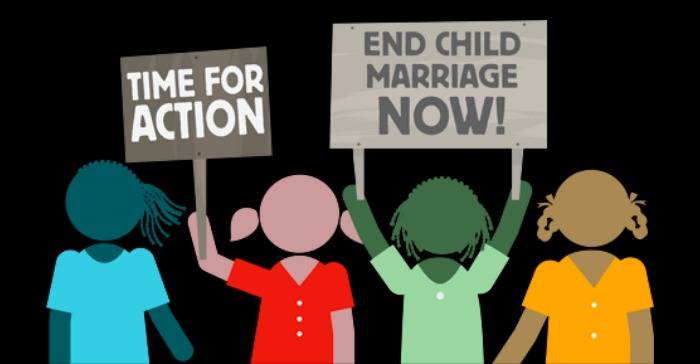

Childhood is like a tender bud that slowly blossoms with time, care, and the gentle attention of parents. It’s a time of carefree living under parental protection—waking up for school, eagerly awaiting the recess bell, and returning home to play in the streets with friends. This is what childhood should be.
But when a girl or boy is bound into a relationship at such an innocent age—one they do not even understand—is this not a clear injustice?
Imagine a simple village anywhere in Pakistan, far from the glitter of affluent areas. A wedding is taking place. Women and young girls watch the bride dressed in red, her hands adorned with henna, and soak in the festive atmosphere. Their eyes sparkle, and these scenes are imprinted on their minds like a dream.
These innocent sights lead young girls to see marriage as a beautiful game—one whose reality they do not yet understand. They play “house” with their friends, arranging marriages between dolls, stitching clothes, and parading a doll’s wedding procession from one house to another. The game continues for days, full of carefree laughter and innocent wishes.
But then comes a day when a girl with the doll suddenly says, “I don’t like your doll anymore,” ending the relationship there—because it was only a game, where decisions could be changed at will.
In real life, however, when a young girl is married off at an early age, she neither understands the true nature of the relationship nor can she make decisions for herself. Breaking free from that bond is extremely difficult; she often must wait until adulthood even to express her wishes or seek separation.
According to international reports, Pakistan is among the countries with a high rate of child marriage. An estimated 19 million girls are married before the age of eighteen, underscoring the seriousness of this social issue.
Although Pakistan has laws to prevent child marriage, their enforcement is uneven. In Islamabad, Sindh, and Balochistan, the minimum legal age for marriage is eighteen for both boys and girls, with penalties for violations. In contrast, Punjab and Khyber Pakhtunkhwa set the minimum age at eighteen for boys but only sixteen for girls—a disparity human rights organisations urge to change.
Data shows child marriage is more common in Balochistan and Sindh. One survey found about 22.5 percent of young people in Balochistan, 17 percent in Sindh, and 13.8 percent in Khyber Pakhtunkhwa were married early. Experts argue that having a uniform minimum age for marriage nationwide is essential to curb this practice.
Despite remarkable global progress, some social attitudes remain rooted in outdated thinking. In many households, the birth of a daughter still brings a silent sense of burden. Worries about dowry, finding a suitable match, and societal pressure quickly follow.
Because of these fears, some parents see marrying their daughters off early as a solution. Later, if the girl faces injustice, conflict, or hardship after early marriage, she is often told to endure it patiently, as if her suffering is destiny, not the result of a premature decision.
Child marriage creates serious problems, especially for mental and physical health. At such a young age, children are still trying to understand puberty, yet they are forced to take on the heavy responsibilities of married life.
If a young girl becomes pregnant soon after marriage, her health and the child’s health are at risk. Medical experts warn that early pregnancies increase the chances of malnutrition, weakness, and complications during childbirth. Similarly, young boys are suddenly faced with financial and family responsibilities when they should be focused on education and developing life skills. As a result, unemployment, poverty, domestic conflict, and even violence can arise—problems that may affect future generations.
In 2023, the Supreme Court ordered that a fourteen-year-old girl be returned to her parents along with her two children, after it was found she lacked the maturity to understand marriage at such a young age. When asked, she chose to live with her parents—an incident that highlights the human and protective side of this issue.
Under the Juvenile Justice System Act 2018, a child is defined as anyone under eighteen. Similarly, Sections 82 and 83 of the Pakistan Penal Code recognise that young children lack the maturity to understand the consequences of their actions, so certain acts at an early age are not treated as crimes.
When the law itself acknowledges that children lack the maturity to fully comprehend the consequences of their actions, it raises an important question: Does the mere onset of puberty make a young person capable of understanding the lifelong responsibilities of marriage?
Religious and social sensitivities around child marriage must be respected. Still, if we agree that marriage requires maturity and understanding, then it is essential to wait until children reach physical, mental, and economic adulthood. Marriage is not just a ritual—it is a lifelong responsibility.
Even adults sometimes struggle with the challenges and decisions of married life. How can young children be expected to bear such burdens? Rather than seeing marriage as a quick solution, society should focus on education—teaching children right from wrong and how to make informed life choices.
Just as the age of eighteen is required for voting and driving, marriage also demands that both the boy and girl reach mental and social maturity. Only then can this bond be fulfilled with responsibility and awareness, not compulsion.