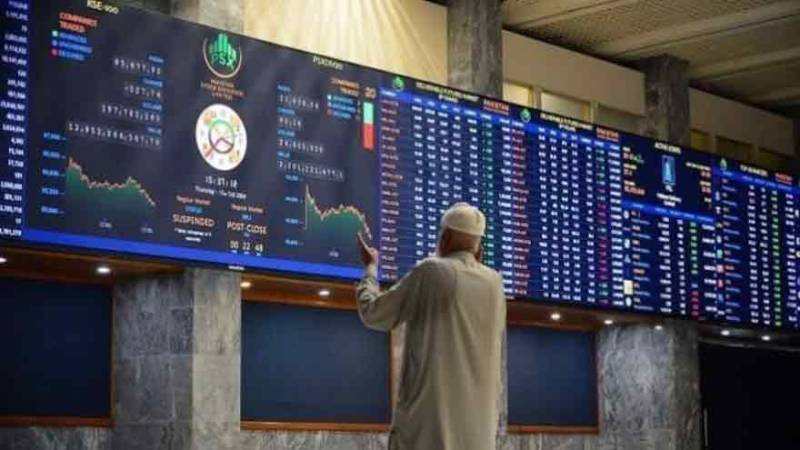

The Pakistan Stock Exchange (PSX) witnessed a volatile trend on Wednesday as geopolitical jitters from escalating tensions in the Middle East triggered a sell-off, with the benchmark KSE-100 Index dropping over 1,300 points at close.
The market opened on a bearish note, and the KSE-100 Index fell by 2,341.36 points to 154,790.73 around 9:20 am. The benchmark later recovered part of the losses, gaining at least 800 points to reach 157,962.47 by 10:00 am.
At close, the market settled at 155,777.21, down by 1354.88 points or 0.86% from the previous close.
Market sentiment remained subdued as uncertainty surrounding developments in the Middle East continued to weigh on investor confidence.
Selling pressure was visible across major sectors, including automobile assemblers, cement, commercial banks, exploration and production companies, oil marketing firms and power generation.
Index-heavy stocks such as Oil and Gas Development Company Limited, Mari Energies Limited, Pakistan Oilfields Limited, Pakistan Petroleum Limited, Hub Power Company, Habib Bank Limited, Meezan Bank Limited and National Bank of Pakistan traded in negative territory.
Earlier on Tuesday, the Pakistan Stock Exchange (PSX) rebounded, gaining more than 5,000 points after a sharp correction, following losses exceeding 16,000 points triggered by escalating Middle East tensions.
The benchmark KSE-100 Index settled at 157,132.09 points, up 5,159.10 points, or 3.39%.
During the session, the index rose to an intraday high of 158,217.01, gaining 6,244.02 points, or 4.11%, and receded to a low of 151,258.85, down 714.14 points, or -0.47%.
The benchmark was trading higher after Monday’s historic plunge, when the index closed at 151,972.99, down 16,089.17 points, or -9.57%, in its biggest ever one-day fall.
Meanwhile, a selloff in stocks deepened and the dollar strengthened as investors considered the implications of US and Israeli strikes on Iran on energy prices and the global economy.