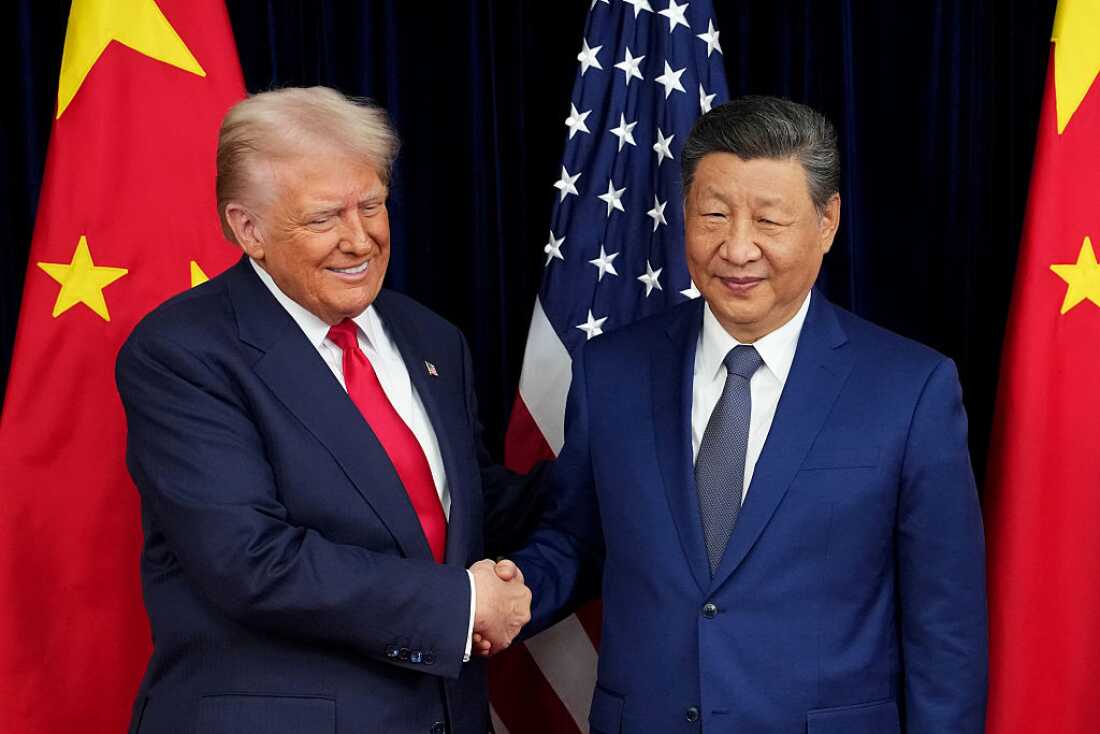

President Trump is visiting China at a time when the world is at a crossroads. On the one hand, the world is facing unprecedented development challenges, while on the other, conflicts and wars are deepening. The Russia-Ukraine war is becoming more complicated with each passing day, and the possibility of restarting the Iran war is becoming more serious. American war mentality, rather love of war, is further complicating the situation. It is unfortunate that despite the Vietnam and Afghanistan wars and the failure to achieve its objectives, the USA did not learn from past experiences. It has even become more eager to start new wars or fan the flames of conflict. Therefore, this mentality is creating more challenges for the USA. On the other hand, the USA is facing serious economic challenges that are worsening. The trade wars and sanctions are not delivering the intended results; rather, they are proving counterproductive.
In this context, it is not difficult to guess why President Trump is traveling to China. He is traveling to find a way to de-escalate tensions between the two countries and secure a deal. He believes the deal is extremely important; rather, it’s a matter of his political survival. As the MAGA base gas started to question President Trump’s policies on the economy, job creation, the welfare of people, and war. He wants to reverse the economic situation and bring back peace, especially in the Middle East. Hence, President Trump is presenting himself as a dove for China and talking about his personal relationship with President Xi.
However, these actions do not align with President Trump’s desires. The Wall Street and City of London hawks in President Trump’s inner circle dislike the doves’ posture. They are determined to check China’s peaceful rise and even call for all-out war with China. They are not in the mood to give any chance to cooperation, let alone make concessions to China to grow and become a global power. They are asking President Trump to take a strict stand against China and continue playing games against Chinese interests.
They want to and are interfering in China’s internal affairs, including Taiwan, Hong Kong, Xinjiang, and Tibet. They have been taking actions to strengthen separatists in Taiwan by providing political support and arms. It is disturbing that, on the one hand, the USA subscribes to One China Policy and, on the other hand, provides weapons and political support to separatists. They are urging President Trump to announce new deals for the Taiwan separatists, which is unacceptable to China. However, they are continuing this policy of ambiguity to engage China and draw it into a hot conflict. Similar strategies are being applied in Hong Kong and Xinjiang. In the case of Hong Kong, they are portraying the rioters who were burning people’s property as heroes of democracy. For Xinjiang, they have fabricated stories of human rights violations and the suppression of Muslims. They are doing all this with one objective: to create internal chaos and weaken the Communist Party of China (CPC).
Second, the USA is pressuring regional countries to form an alliance against China, challenging China’s interests and sovereignty and interfering in China’s internal affairs. Japan is the most prominent example on this front. After Japan’s defeat in World War II, it was prohibited from maintaining an aggressive military. However, over the last few years, the USA has changed its policy and allowed Japan to do whatever it wants. Japan was in search of such a moment and wasted no time in restarting the building of the imperial army. The USA further accelerated the process by offering generous defense and weapons deals. Now, Japan is actively playing an anti-China role in the region and has begun interfering in China’s internal affairs. For example, the Japanese Prime Minister tried to instigate China by making statements on Taiwan. She even spoke about Japan’s possible involvement in hindering China’s reunification.
It is unfortunate that the USA and the West, so-called defenders of human rights, forget the atrocities and genocide committed by Japan in China. This shows the USA’s desperation to contain China and achieve its objectives at any cost.
The Philippines is another example in the region seeking to adopt an anti-China policy. In recent years, the USA has upgraded its defense cooperation with the Philippines by supplying weapons and supporting the Philippines’ claims to certain areas of China in the South China Sea. These actions are part of efforts to create chaos around China.
Moreover, the American establishment is pushing China’s friends to reconsider their relationship with China, and Pakistan is one of the most prominent examples. Since the launch of CPEC, Pakistan has been under immense pressure to roll back CPEC and reconsider its relationship. The USA has deployed multiple global institutions, such as the IMF and FATF, to pressure Pakistan. This policy has been activated to isolate China, curtail its economic and trade relations, and ultimately check China’s peaceful rise.
However, these policies are not working. Despite all hindrances and efforts, China is making progress. Now there are two questions: First, in the presence of a policy of creating chaos within and around China, how can the USA think about a deal? Second, if the policy is not delivering, then why is the USA sticking to it? The analysis of global dynamics, geopolitics, and economic structures indicates that the USA does not want to lose its global status. Moreover, the USA wants to revive its economy. It believes that it can only be achieved through coercive measures. Therefore, some elements oppose this approach and consider the best way is to build cooperation, because China is too big to fall or be controlled.
Now, President Trump is stuck between two extremes: be cooperative or be coercive. President Trump is swinging between these extremes, sometimes tilting towards one side and then the other.
Therefore, the USA policy is considered self-illusory and a confused policy. It shows that the USA does not know what to do or how to revive its economy and maintain its global status.
Thus, rational minds suggest that it is not a sustainable policy or path, and the USA needs to pursue course correction. To course-correct, the USA needs to conduct a SWOT analysis of the current situation, its policies, and actions. The analysis must be grounded in reality, and America must set aside its hegemonic aspirations and self-greatness mentality. This will help reduce confusion and lead to the right policy decisions and actions.
In conclusion, the above discussion indicates that a self-illusory policy rooted in a coercive mentality will not help the USA. It is a self-destructive policy and path. Hence, the USA must reconsider its policy of engagement with China. First, it must adhere to the One China principle and strongly oppose separatists and voices advocating Taiwan’s separation. To that end, it should end political and military support for separatists. Second, it should refrain from patting Japan, the Philippines, and others on the back to build anti-China alliances. America should understand that challenging China would be counterproductive, as China is too strong to be challenged. Third, it should stop pressuring Chinese friends to reconsider their relationship with China. That will not work; rather, this policy will push Chinese friends to distance themselves from the USA. Fourth, the USA must understand global dynamics in light of ground realities and realize that the world needs bridges, not walls.
Lastly, let’s hope that sense will prevail and the USA makes the wise decision to set aside hegemonic aspirations and a self-greatness mentality, and to subscribe to a policy of cooperation. Let’s also hope that the meeting between President Xi and Trump produces a win-win outcome and a peaceful way forward.