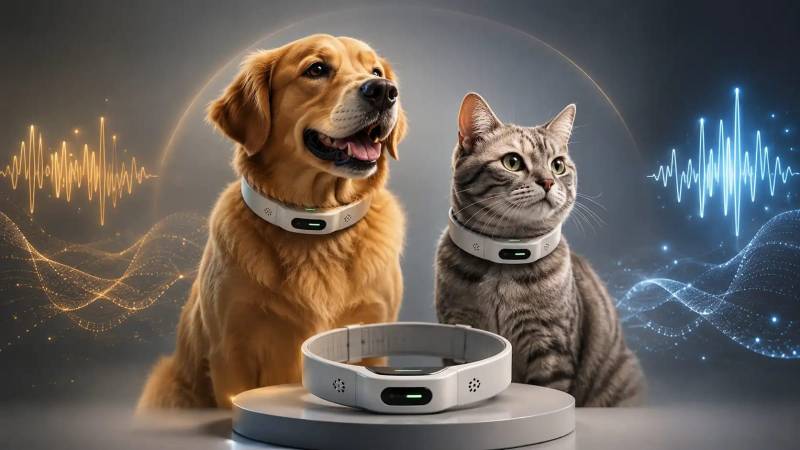

Every dog owner has wished, at least once, that their pet could simply speak and say what’s wrong. Thanks to groundbreaking new research out of Forman Christian College, that reality might be much closer than we think.
In a newly published paper, researcher Maryum Khan from the Department of Business Management outlines the development of the PawTalk Collar, a smart, AI-enabled dog collar designed to bridge the age-old communication gap between humans and their canine companions.
From Barks to Bytes: How It Works
The PawTalk Collar is a lightweight, waterproof wearable device packed with multi-modal sensors. Rather than just tracking a dog’s steps like a standard pet fitness monitor, this device aims to comprehensively decode canine emotions and physical needs.
According to the paper, the system relies on a sophisticated mix of hardware and cloud/edge AI.
Audio & Motion Capture: Integrated microphone arrays track bark frequency, pitch, and duration, while a 3-axis gyroscope and accelerometer monitor motion and posture.
Biometrics & Environment: The collar incorporates physiological indicators (such as heart rate and respiratory monitoring via photoplethysmography) alongside temperature and humidity sensors to gauge environmental context.
The AI Translation: A low-power microcontroller (such as an ESP32) pre-processes the raw data locally before transmitting it to a mobile application. Machine learning models then analyse the inputs to deliver real-time, human-readable insights.
Instead of guessing why a dog is whining, owners will receive clear notifications via an app, with translations like:
”I need to go outside,” “I’m anxious,” “I’m hungry/playful,” or “I’m in discomfort.”
Overcoming the “Ruff” Technical Challenges
While the concept of a pet translator isn’t entirely new, Khan’s research highlights how the PawTalk Collar aims to solve major gaps left by existing wearables—specifically real-time, context-aware interpretation and user-friendly deployment.
However, building a device that can withstand the rigours of daily dog life presents distinct engineering challenges. The paper notes that sensor integration, power management, and the creation of a comfortable, conformal design are paramount. Khan points out that surface topography under the sensor layer can severely affect signal quality. To combat data loss caused by non-conformal sensor placement, the architecture utilises flexible substrates and advanced fastening mechanisms.
Why It Matters
Misunderstanding a dog’s vocalisations and body language is a leading cause of frustration for owners, often resulting in behavioural issues or inadequate care. By translating repetitive barks and physiological data into actionable insights, the PawTalk Collar aims to drastically reduce miscommunication, enhance pet welfare, and deepen the bond between humans and their pets.
As the project advances with performance evaluations and pathways from input signals to actionable outputs, the pet tech industry may be poised for the next major leap in animal-computer interaction.