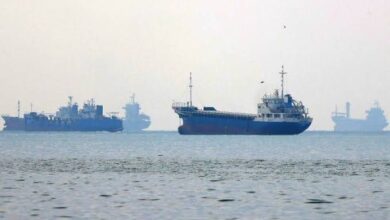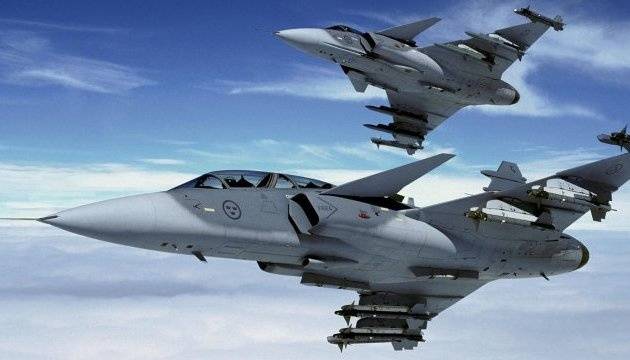

Finland’s air force said Friday that Swedish and Finnish fighter jets had been scrambled to identify Russian fighter jets flying over the Gulf of Finland.
The air force said that the two Nordic countries’ Quick Reaction Alert (QRA) jets had been scrambled on Thursday.
They had identified a Russian detachment consisting of a Tu-134 transport aircraft, MiG-31 fighter jets and Su-30 fighter jets “in international airspace over the Gulf of Finland.”
According to the military it was the first joint operational “identification mission” for the two air forces.
Tensions over the Baltic Sea have risen sharply in recent years, and Nordic jets are regularly scrambled to intercept Russian aircraft.
In the wake of Russia’s 2022 invasion of Ukraine, Sweden and Finland both dropped decades of military non-alignment and joined NATO.
Swedish Prime Minister Ulf Kristersson commented on the operation on X, saying that “the Baltic Sea has never been as vulnerable as it is now — but it has also never been better protected than it is right now.”
Patriot licence
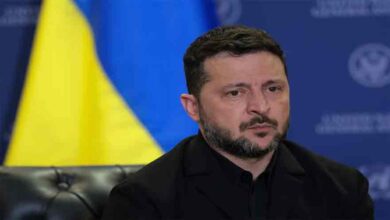
Ukrainian President Volodymyr Zelensky on Friday said US President Donald Trump told him he would allow Ukraine to produce advanced Patriot air defence missiles, after a series of reversals on the issue.
Kyiv is facing a shortage of the missiles, which remain the only ones reliably able to counter the ballistic missiles that Russia launches at Ukraine.
“At our last meeting, President Trump emphasised to me that yes, I have made a final decision. Ukraine will receive licences for the production of Patriot missiles,” Zelensky said in a voice note to journalists.
In July, Trump said it would be “pretty cool” to grant Ukraine the licences, before backtracking, saying the United States should be “very careful” before granting Ukraine authorisation.
Ukraine has reported an acute shortage of Patriot interceptors since the United States and Israel went to war with Iran in February, diverting supplies of the advanced systems.
Even if the licences are granted, establishing industrial capacity would require more than a year and would not meet Kyiv’s immediate needs.
And Kyiv has renewed calls for urgent support ahead of winter, and the threat of a repeated campaign of Russian strikes against Ukraine’s power and heating infrastructure.
Kyiv needs five percent of the United States’ Patriot interceptor missiles to get through the winter and 10 percent to destroy all of Russia’s ballistic projectiles, Zelensky said last month.
In parallel, he said Kyiv is working on its own anti-ballistic systems, Freya.