

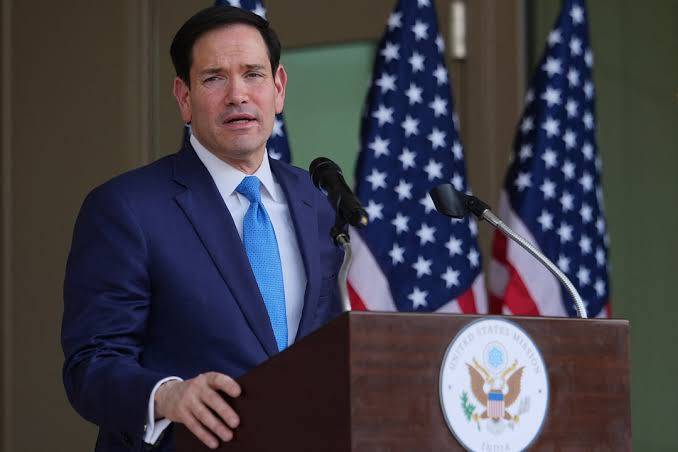

US Secretary of State Marco Rubio has said that further US military action against Iran is unnecessary because the economic pain the US is inflicting on a weakened Islamic Republic is so great.
Rubio’s comment in a speech to the Federalist Society on Friday reinforced a statement by US President Donald Trump earlier in the week that the war “militarily is effectively over.”
“And right now, frankly, the economic pain that we are inflicting on that regime is so great that there’s no need for military action because we’ve weakened them so much,” Rubio said. “But I think victory is ensuring that they never have a nuclear weapon.”
Rubio also acknowledged the economic pain Americans have experienced as a result of the war, which has driven up fuel costs and affected nearly every sector of the global economy.
It would have been easy for Trump to ignore the threat posed by Iran’s nuclear program, avoid an unpopular war and “leave it for the next person to worry about,” he said, adding that the president decided he was “not going to leave it unaddressed.”
“But it’s hard,” Rubio said. “It’s not easy and it’s difficult. And oftentimes it inflicts, you know, pain, economic pain and otherwise. So we recognize that.”
Meanwhile, the US military said Friday it shot down two Iranian attack drones headed toward Bahrain, denying Iran’s claim that it had struck a US radar system in the kingdom. CENTCOM, the US command centre covering the region, said there were no injuries or damage.
Iran’s official IRNA news agency cited a Revolutionary Guard statement that said the attack on the radar system followed a US strike on a telecommunications pole in the southern Iranian port of Sirik. It was Iran’s first report of targeting a facility in Bahrain since September.
Bahrain’s Ministry of Information did not immediately respond to requests for comment.
In a related development, the United Nations said October had the highest number of incidents against commercial ships in the contested waters since February, when the Iran war began.
The UN’s International Maritime Organization said 25 seafarers died and many others were injured or remain missing following some 134 incidents in the Strait of Hormuz and the wider Middle East maritime area as of Nov. 11.
Iran told the United Nations’ nuclear watchdog that discussions on nuclear monitoring cannot proceed while the country is facing military threats.
According to a confidential report by the International Atomic Energy Agency, Iran insists inspections cannot resume amid threats from the US to target its nuclear facilities. Iran hasn’t given inspectors access to sites affected by Israeli and US strikes during the June 2025 war.
Iran’s deputy UN ambassador, Gholamhossein Darzi, told the UN Security Council Friday that its response to any renewed fighting would be “directed against the source of aggression, wherever it may be.”
Putting a damper on the prospect of new talks, he said US threats and attacks during “good faith” negotiations over the last two years “have created profound distrust and serious doubt about the prospects of renewed negotiations without credible guarantees against the repetition of such unlawful actions.”
Darzi clashed with Bahrain, which called the meeting on behalf of the six Gulf Cooperation Council countries, as well as the United States.