As the world begins to travel again, Europe is sending migrants and refugees a loud message: Stay away!
Greek border police are firing bursts of deafening noise from an armoured truck over the frontier into Turkey. Mounted on the vehicle, the long-range acoustic device, or “sound cannon,” is the size of a small TV set but can match the volume of a jet engine.
It is part of a vast array of physical and experimental new digital barriers being installed and tested during the quiet months of the coronavirus pandemic at the 200-kilometre (125-mile) Greek border with Turkey to stop people from entering the European Union without documents.
A new steel wall, similar to recent construction on the United States-Mexico border, blocks commonly-used crossing points along the Evros River that separates the two countries.
Nearby observation towers are being fitted with long-range cameras, night vision and multiple sensors. The data will be sent to control centres to flag suspicious movement using artificial intelligence analysis.
“We will have a clear ‘pre-border’ picture of what’s happening,” Police Major Dimosthenis Kamargios, head of the region’s border guard authority, told the Associated Press.
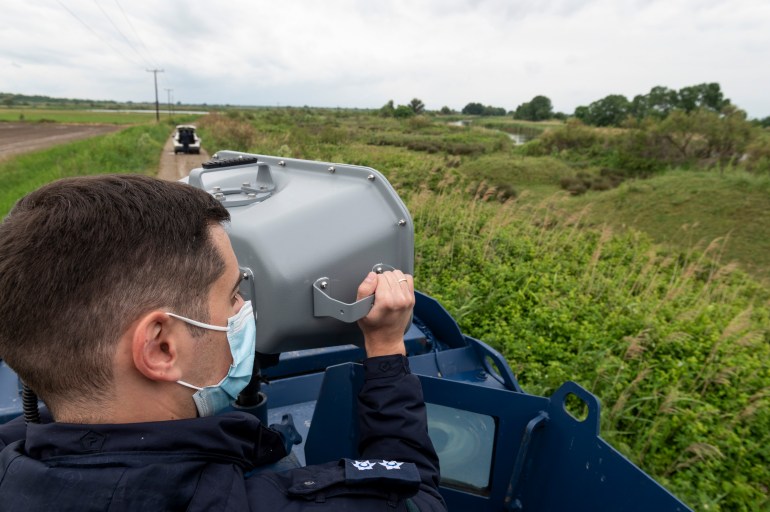 Police officer Dimitris Bistinas operates a long-range acoustic device, attached to a police vehicle, during a patrol alongside the Greek-Turkish border near the town of Feres, Greece [Giannis Papanikos/AP]
Futuristic surveillance
The EU has poured three billion euros ($3.7bn) into security tech research following the refugee crisis in 2015-16, when more than one million people – many escaping wars in Syria, Iraq and Afghanistan – fled to Greece and on to other EU countries.
The automated surveillance network being built on the Greek-Turkish border is aimed at detecting migrants and refugees early and deterring them from crossing, with river and land patrols using searchlights and long-range acoustic devices.
Key elements of the network will be launched by the end of the year, Kamargios said. “Our task is to prevent migrants from entering the country illegally. We need modern equipment and tools to do that.”
Researchers at universities around Europe, working with private firms, have developed futuristic surveillance and verification technology, and tested more than a dozen projects at Greek borders.
AI-powered lie detectors and virtual border-guard interview bots have been piloted, as well as efforts to integrate satellite data with footage from drones on land, air, sea and under water.
Palm scanners record the unique vein pattern in a person’s hand to use as a biometric identifier, and the makers of live camera reconstruction technology promise to erase foliage virtually, exposing people hiding near border areas.