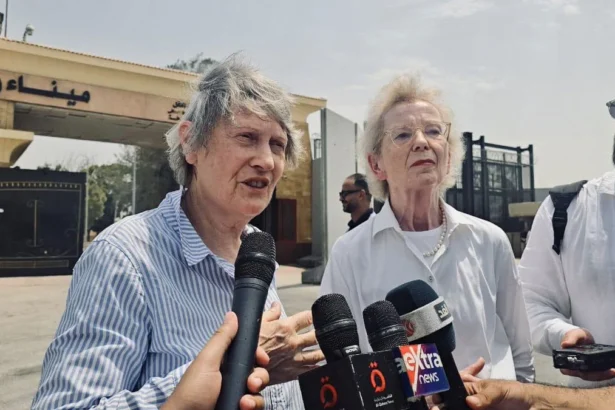

Two senior members of The Elders, an international group founded by Nelson Mandela, have warned that the possibility of an independent Palestinian state is becoming increasingly uncertain. Former Irish president Mary Robinson and former New Zealand prime minister Helen Clark urged the international community to take stronger action, saying the situation in the Palestinian territories has worsened significantly in recent years.
The two leaders made the remarks after completing a regional visit that included Israel, the occupied Palestinian territories, Jordan and Lebanon. During their meetings with political leaders, civil society groups and local communities, they said they witnessed growing concern over the future of Palestinian land and the continuing expansion of Israeli settlements.
In a joint statement, Robinson and Clark accused the Israeli government led by Prime Minister Benjamin Netanyahu of pursuing policies that threaten the existence of a future Palestinian state. They argued that continued settlement expansion and political decisions were weakening Palestinian communities and reducing the chances of a lasting peace agreement.
Speaking to reporters in Jerusalem, Helen Clark said one of the strongest messages they heard throughout their visit was the need for greater accountability. She said many people they met in the West Bank and East Jerusalem believed there was too little international action in response to developments on the ground. According to Clark, local communities want stronger efforts to ensure that international law is respected and that violations do not go unchallenged.
Mary Robinson also criticised the response of the European Union, saying she believed it should adopt a firmer position. She called on European leaders to suspend the trade component of their association agreement with Israel and to ban products originating from Israeli settlements in the occupied territories. Robinson said stronger diplomatic and economic measures were needed if the international community wanted to help preserve the possibility of a two state solution.
The former leaders said conditions in the West Bank had noticeably deteriorated since their previous visit in 2023. They warned that continued settlement construction could permanently alter the situation, making it increasingly difficult for Palestinians to establish an independent and viable state in the future.
According to the Israeli anti settlement organisation Peace Now, the current Israeli government has approved more than 100 new settlements in the West Bank since taking office. The United Nations has also reported a rise in violence involving Israeli settlers since the Gaza war began in 2023. At the same time, some Israeli government ministers have publicly supported the annexation of parts or all of the West Bank.
More than 500000 Israeli settlers currently live in the occupied West Bank, excluding East Jerusalem, alongside around three million Palestinians. The settlements are widely regarded as illegal under international law, although Israel disputes that interpretation.
During their visit, Robinson and Clark also met Israeli President Isaac Herzog. Robinson acknowledged that the discussions revealed major differences between the two sides. The Israeli presidency later said President Herzog rejected what it described as one sided criticism of Israel’s actions during the ongoing conflict.
The comments by the two former leaders add to growing international debate over the future of the Israeli Palestinian conflict as diplomatic efforts continue to face significant challenges and the prospects for a negotiated peace remain uncertain.