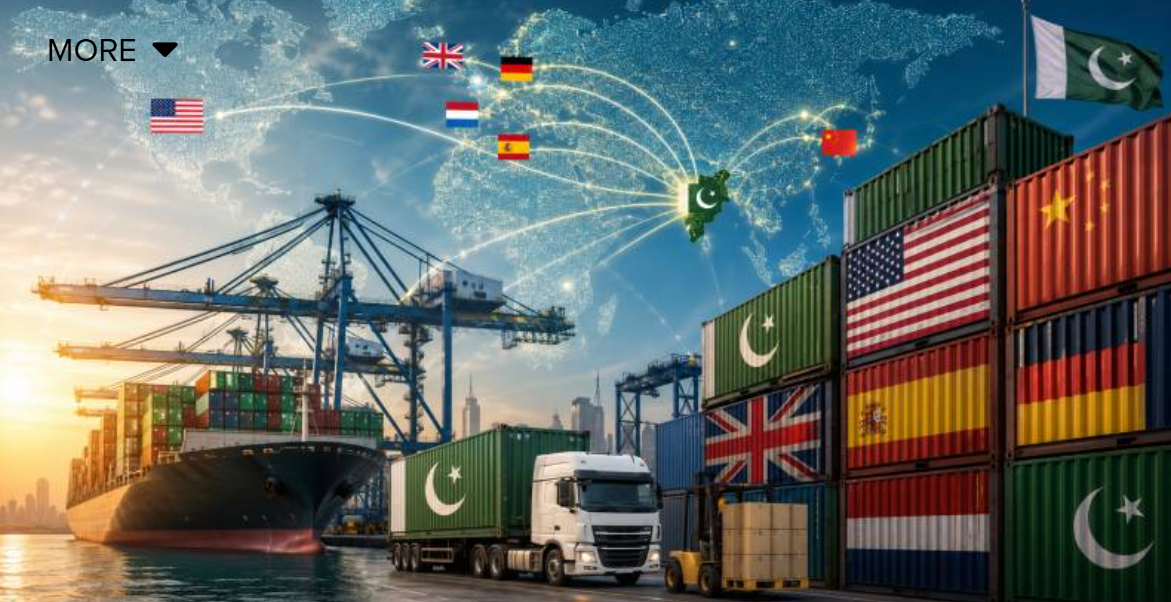

The United States remained Pakistan’s largest export destination during fiscal year 2025-26, accounting for about 20% of the country’s total overseas shipments, according to trade figures attributed to the State Bank of Pakistan.
Pakistan exported goods worth $2.86 billion to the US during the fiscal year, underlining the American market’s continued importance for the country’s export sector.
The State Bank publishes monthly data covering Pakistan’s export receipts and import payments by country, with the latest country-wise figures updated on July 17.
China was Pakistan’s second-largest export partner, receiving about 9% of the country’s total exports, while the United Kingdom ranked third with a share of approximately 7%.
Pakistan’s exports to the UK stood at $1.423 billion, followed closely by shipments worth $1.377 billion to Spain.
Exports to the Netherlands were recorded at $942 million, while Germany purchased Pakistani goods worth $765 million during the fiscal year.
The figures showed that Pakistan continued to depend heavily on a limited number of international markets for its export earnings. The five leading destinations collectively accounted for nearly half of the country’s total exports during FY26.
The concentration highlights the importance of the US and major European markets for Pakistani exporters, particularly at a time when merchandise exports have faced pressure from changing international demand and growing competition in global markets.
Pakistan maintained favourable trade balances with the United States, the United Kingdom, Spain, the Netherlands and Germany, as its exports to those markets exceeded imports from them.
The US continued to be Pakistan’s most important individual export market, providing the country with a significant trade surplus and a major source of foreign exchange earnings.
In contrast, Pakistan recorded large trade deficits with several of its leading import partners, particularly China and oil-exporting Gulf countries.
The country’s largest bilateral trade deficit was recorded with China at $16.85 billion during FY26, reflecting Pakistan’s substantial imports of machinery, industrial inputs, electrical equipment and other manufactured products.
The trade deficit with the United Arab Emirates stood at $6.25 billion, while the gap with Saudi Arabia reached $3.36 billion.
Pakistan also recorded trade deficits of $3.26 billion with Qatar and $2.23 billion with Singapore.
The Pakistan Economic Survey has similarly noted that the country runs a substantial trade deficit with China because of its dependence on Chinese machinery, raw materials, intermediate goods and capital equipment. Imports from the UAE are largely associated with energy products and re-exported goods, while Pakistan generally maintains a trade surplus with the United States.
The country-wise figures illustrate two contrasting features of Pakistan’s external trade: export earnings remain concentrated in the US and a small group of European markets, while imports are dominated by China and major energy suppliers in the Gulf.
The trends indicate that expanding access to new markets, improving product diversification and increasing exports to existing trade partners will remain central to reducing Pakistan’s persistent external trade imbalance.