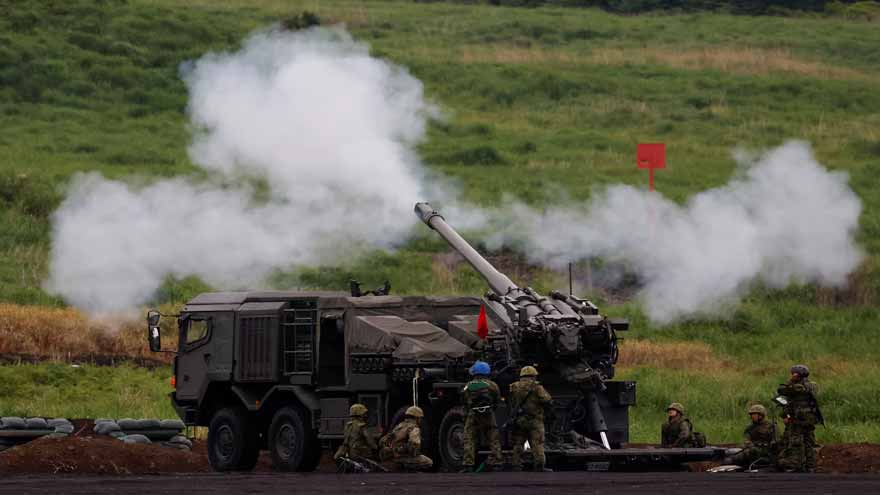

TOKYO: Japan’s government is portraying its accelerating military buildup not only as a way to protect the country but as a route to greater prosperity, arguing in its latest defence white paper that arms production can support economic growth.
The annual assessment of threats posed by neighbouring China, Russia and North Korea calls for Japan, constrained for decades by postwar restrictions on military activity, to harness technology, to fund startups and use more commercial components in weapons production.
The white paper “stresses that investment in defence benefits the wider economy and people’s lives,” according to a Defence Ministry presentation document. That message aligns with Prime Minister Sanae Takaichi’s broader use of strategic state spending in an effort to drive economic growth.
The pitch is reinforced by the document’s anime-style cover, which depicts a smiling family in a gleaming cityscape rather than the troops, weapons and military insignia featured on many previous editions. A Defence Ministry official said the design was intended to convey a “futuristic image”.
The link between defence and future prosperity comes as Takaichi’s administration prepares a new national security strategy. Military experts expect it to call for further spending increases aimed primarily at deterring China from starting a conflict with Taiwan that could also draw Japan into a prolonged war.
“China’s military activities and other actions are a matter of serious concern to Japan and the international community, and represent Japan’s greatest strategic challenge,” the white paper said.
Beijing reacted furiously in November when Takaichi said Japan could deploy its Self-Defense Forces if a Chinese attack on Taiwan also threatened Japan’s survival, demanding that she retract what it called an “egregious” remark.
Tokyo has assembled a patchwork of tax increases, spending reforms and one-off revenues to finance Japan’s largest military buildup since World War Two, which has pushed defence-related spending to 2% of gross domestic product. But Takaichi has yet to explain clearly how she would pay for a further expansion without adding pressure on Japan’s already stretched public finances.
Her government secured a record 122.3 trillion yen budget for the year to March 2027 and later added a 3.1 trillion yen supplementary package to cushion households and businesses from higher energy costs, underscoring the competing demands on the public purse.
Much of the new defence spending so far has gone on missiles capable of striking targets more than 1,000 km (621 miles) away. A significant share of any further increase is expected to go toward drones and other unmanned weapons of the kind deployed extensively by Ukraine in its war with Russia.