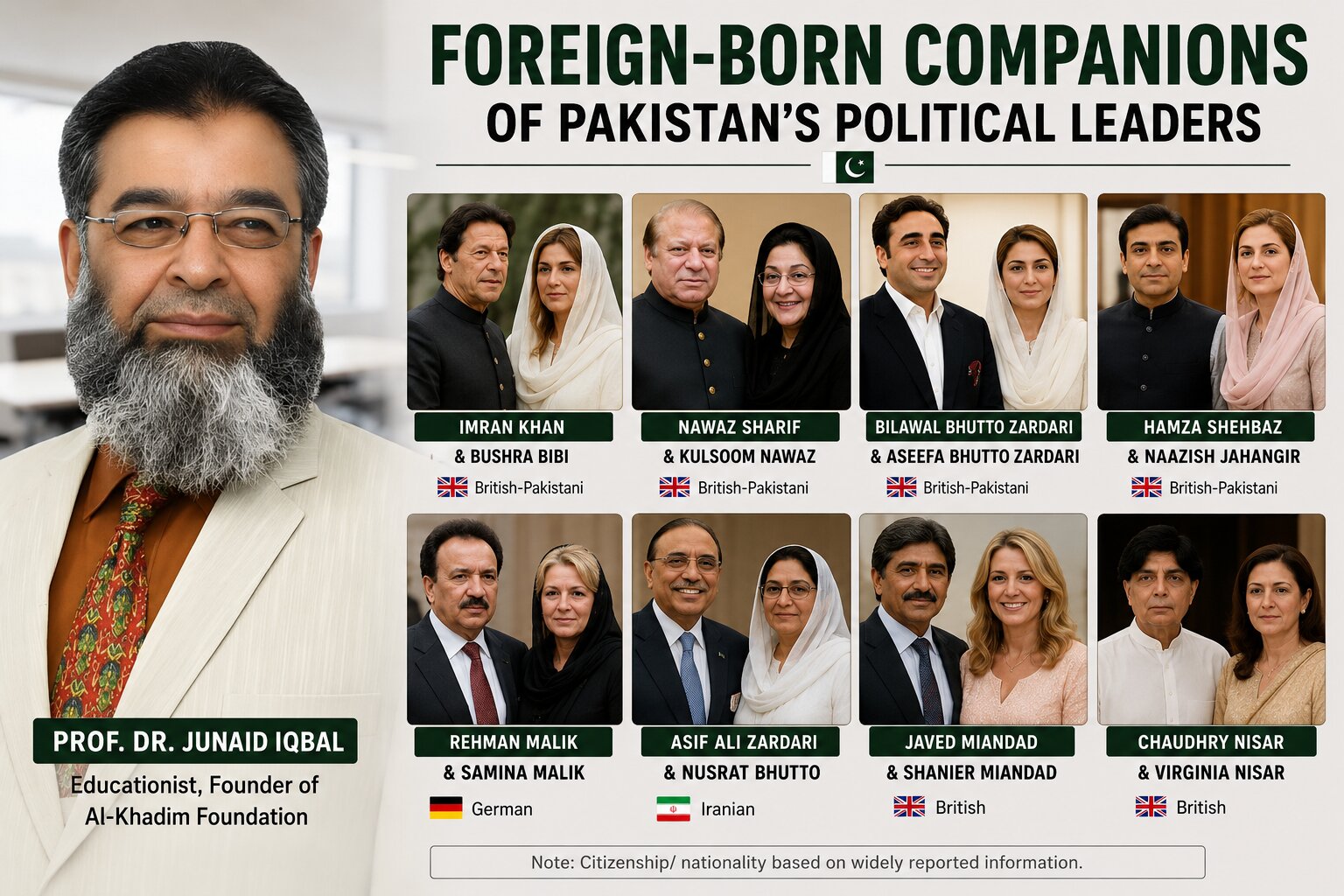

Politics is generally regarded as a realm in which national interests, public responsibilities and political traditions dominate almost every aspect of a leader’s life. Yet the personal lives of political leaders sometimes reveal a fascinating dimension of history that lies beyond parliaments, elections and governments. Pakistan’s political history provides several remarkable examples of prominent leaders whose lives were closely connected with women born outside the country or belonging to foreign nationalities.
From the early years of the Sub-Continent to contemporary Pakistan, marriages between Pakistani political leaders and women of foreign origin have occasionally attracted considerable public attention. Some of these marriages crossed national boundaries; others crossed religious, cultural or social barriers. Together, they provide an interesting glimpse into the cosmopolitan character of Pakistan’s political elite.
The story begins, in a broader sense, with the country’s founding father, Quaid-i-Azam Muhammad Ali Jinnah. Jinnah married Rattanbai “Ruttie” Petit on 19 April 1918. Ruttie belonged to the prominent Parsi Petit family of Bombay and converted to Islam before the marriage. The official Quaid-i-Azam Academy records that Jinnah waited until she attained the age of eighteen before marrying her, despite strong opposition from her father, Sir Dinshaw Petit. Strictly speaking, however, Ruttie should not be described as a foreign woman. She was born in Bombay, then part of British India, rather than in a foreign country. Her marriage to Jinnah was therefore principally an extraordinary interfaith and cross-community marriage, rather than a Pakistani-foreign marriage. Nevertheless, it remains one of the most remarkable personal chapters in the life of the man who would later create Pakistan.
A similar case is that of Liaquat Ali Khan, Pakistan’s first Prime Minister, and Begum Ra’ana Liaquat Ali Khan. Born Sheila Irene Pant in 1905 into a Kumaoni family of Almora in British India, of originally Brahmin background that had converted to Christianity, she embraced Islam, married Liaquat in 1933, and became a distinguished social worker, diplomat and First Lady. Though of Indian origin within the old imperial territories, her life illustrates the same crossing of communal and cultural lines.
A much clearer example is that of Zulfikar Ali Bhutto and Begum Nusrat Bhutto. Nusrat Ispahani was born on 23 March 1929 in Esfahan, Iran, into the wealthy Hariri family, of Iranian-Kurdish background. She received her education at the University of Esfahan and met Zulfikar Ali Bhutto in Karachi. They married on 8 September 1951. Begum Nusrat Bhutto subsequently became much more than the wife of a political leader. When Zulfikar Ali Bhutto became President and later Prime Minister, she served as First Lady and accompanied him on several foreign visits. Following her husband’s execution in 1979, she assumed the leadership of the Pakistan Peoples Party and remained an important figure in Pakistani politics. She was the mother of Benazir Bhutto, Murtaza Bhutto, Shahnawaz Bhutto and Sanam Bhutto.
The pattern of foreign marriages continued within the family. Mir Murtaza Bhutto first married Fauzia Fasihuddin, an Afghan and daughter of an Afghan foreign-affairs official, while in exile in Kabul; they had a daughter, Fatima Bhutto, and later divorced. He then married Ghinwa Itaoui, of Lebanese origin, who had fled the Lebanese Civil War and was teaching ballet in Syria, with whom he had a son, Zulfikar Ali Bhutto Jr. Shahnawaz Bhutto married Rehana Fasihuddin, the Afghan sister of Fauzia. Fatima Bhutto’s marriage to Graham Byra, an American who converted to Islam represents the reverse case of a Bhutto woman marrying a foreign man.
Another Iranian connection appears in the life of Iskander Mirza, Pakistan’s first President. His second wife, Nahid Mirza, born in 1919 of Kurdish and noble Iranian descent, had previously been married to an Iranian military attaché. They wed in 1954, and she served as First Lady from 1956 to 1958. Some accounts note a cousinly link with Nusrat Bhutto.
Mohammad Ali Bogra, Pakistan’s third Prime Minister, provides a further instance with his second wife, Aliya Begum. Aliya was a Lebanese woman whose family had settled in Canada. She had worked with Bogra when he was associated with Pakistan’s diplomatic mission and subsequently became Social Secretary to the Prime Minister. They married after Bogra became Prime Minister. Contemporary historical accounts describe the marriage as controversial, partly because Bogra was already married and the union therefore became associated with the debate surrounding polygamy among Pakistan’s elite.
The story of Huseyn Shaheed Suhrawardy is even more unusual. Suhrawardy, who later became Pakistan’s Prime Minister, married Vera Tiscenko in 1940. Vera was a Russian actress of Polish descent associated with the Moscow Art Theatre. Historical accounts record that she had fled revolutionary upheaval in Europe and eventually came to India. She converted to Islam and adopted the name Begum Noor Jehan. Suhrawardy and Vera later divorced in 1951. Vera’s life itself was extraordinarily cosmopolitan. She had experienced the upheavals of revolutionary Russia and Europe before becoming connected with the political world of British India and, subsequently, Pakistan. Her marriage to Suhrawardy therefore represented not merely a personal union between two individuals but a remarkable encounter between European and South Asian histories.
Feroz Khan Noon provides perhaps the most striking example of an Austrian-born woman becoming the wife of a Pakistani Prime Minister. His wife, Victoria Rekha (Viqar-un-Nisa Noon), was born in Austria. The Austrian Federal Ministry for European and International Affairs specifically identifies her as the Austrian-born wife of Prime Minister Feroz Khan Noon and notes her significant contribution to the politics of Pakistan and to relations between Austria and Pakistan. She married Feroz Khan Noon in 1945 and later became widely known as Begum Viqar-un-Nisa Noon. Her significance extended beyond her marriage. She became involved in public and political affairs and is remembered as one of the foreign-born women who became deeply associated with Pakistan’s national story.
The modern era produced another internationally famous political marriage; that of Imran Khan and Jemima Goldsmith. Imran Khan married Jemima in Paris in 1995. She was the daughter of British financier James Goldsmith. The couple had two sons, Sulaiman and Qasim, and their marriage lasted approximately nine years before ending in divorce. Her marriage to Imran Khan attracted enormous attention because Khan was already an internationally recognised sportsman and public figure before entering politics.
There is, however, a contemporary name that requires particular caution; Bilawal Bhutto Zardari. In recent days, reports have circulated on social media and in some media outlets claiming that Bilawal Bhutto Zardari might marry a woman connected with Austria’s former royal family. Some reports even named Gloria von Habsburg as the alleged prospective bride. Bilawal himself denied the reports on social media, and on 29 August 2026 PPP leader and Karachi Mayor Murtaza Wahab, who also serves as a spokesperson for Bilawal, publicly rejected the story as “incorrect and unfounded.” There has been no official announcement from Bilawal Bhutto Zardari or his family confirming an engagement or wedding. He remains unmarried. Consequently, Bilawal should not presently be included in a historical list of Pakistani politicians who married foreign women.
These marriages demonstrate that Pakistan’s political history has never been completely isolated from the wider world. Long before globalisation became a defining feature of modern life, Pakistan’s political families were connected with Iran, Lebanon, Russia, Austria, Britain, Afghanistan and other parts of the world. Yet perhaps the most important lesson is that history must distinguish between fact and fascination. Political personalities naturally attract rumours about their private lives, particularly when those lives involve foreign families, royalty or prominent personalities. But responsible historical writing requires that documented marriages be separated from speculation. The story of Pakistani political leaders and foreign-born women is therefore not merely a collection of unusual marriages. It is a small but revealing chapter in the country’s history—a reminder that political Pakistan, despite its strong national identity, has always existed within a much wider human, cultural and international landscape.