


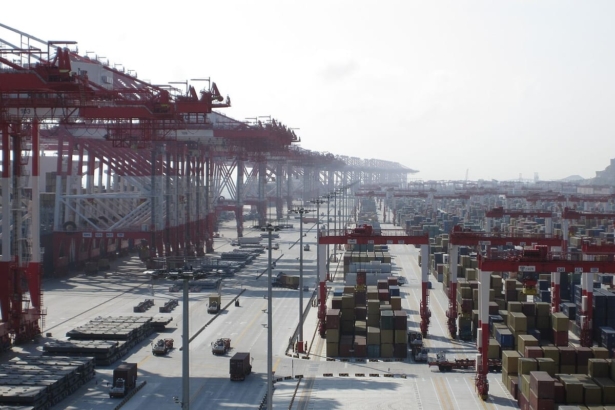

BEIJING: China exports rose 36.3% in September on the year, beating forecasts and putting Beijing on track for a record annual trade surplus, customs data showed.
Growth sped up from 25% in August. In fact, September’s pace was the quickest since February, as shipments of semiconductors, cars and other high-tech goods climbed.
Imports also grew strongly, rising 31% compared with 28.2% the month before. The gap between exports and imports nonetheless grew to $133.5 billion, against $119.1 billion a month before.
China exports led by chips and cars
From January to September, the trade surplus hit $938 billion. Consequently, many economists now expect the full-year total to pass last year’s record of $1.2 trillion.
The value of semiconductor shipments more than doubled over those nine months, rising 108.1%. Data processing equipment and parts climbed 54.6%, while vehicle shipments grew 54.3% as buyers abroad snapped up Chinese electric cars and hybrids.
Strong China exports have propped up growth this year. At home, by contrast, spending and investment remain weak after years of trouble in the property market.
Trade partners push back on China exports
However, resistance is building. The EU runs a trade deficit with China of more than $1.1 billion every day, and it wants Beijing to narrow the gap.
Following talks in Beijing last week, EU trade chief Maros Sefcovic announced a deal. Under that agreement, the bloc would take only half as many Chinese hybrids within a few years.
“The EU’s push to rebalance directly targets high-value exports,” said Ecaterina Bigos of BNP Paribas Asset Management.
Many trading partners face weak growth and fear that Chinese goods could swamp their factories, said Eswar Prasad, an economics professor at Cornell University. Bigos added that diversifying into Southeast Asia and Latin America cannot fully replace demand from Western countries.
Washington, meanwhile, struck a deal with Beijing last month to prolong their trade truce. As part of it, both sides lowered tariffs on goods worth $60 billion, although a US probe into excess Chinese industrial capacity continues.
Policymakers have also pointed to a weak yuan for making Chinese goods cheaper abroad. Beijing denies this, saying it has “no need or intent” to devalue its currency for an edge.
Soybean buying resumes
In another sign of calmer ties with the US, Chinese state firms bought 8 to 10 shiploads of US soybeans this week, traders said. These marked the first such purchases since Trump and Xi Jinping met in September.
Each Panamax vessel carries roughly 65,000 tonnes, and shipments will begin in December. So far, China has bought about 13.7 million tonnes for the 2026/27 season, past the halfway mark of its 25 million-tonne target.
Looking ahead, analysts warn of risks. “A slowdown in the global AI investment cycle could pose a greater threat,” said Max Zenglein of The Conference Board.
Beijing has set a growth goal of 4.5% to 5% for 2026. This week, the International Monetary Fund lowered its China forecast to 4.5%, even as China exports keep outperforming expectations.