

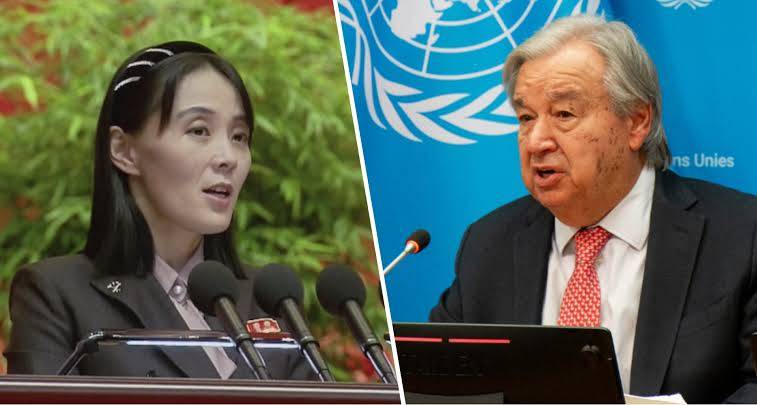

PYONYANG: North Korea’s Kim Yo Jong, the leader’s powerful sister, accused UN chief Antonio Guterres on Tuesday of adopting a “prejudiced and irresponsible attitude” after he called for renewed dialogue with the South.
Guterres last week expressed concerns about a potential escalation on the Korean peninsula, calling on Pyongyang and Seoul “to resume communication channels, including on the military-to-military level, to avoid unintended accidents or miscalculations”, according to UN spokesman Stephane Dujarric.
Tensions between the two Koreas, which remain technically at war, have soared since a landmine explosion along their heavily fortified border in September wounded three South Korean soldiers.
Seoul blamed the explosion on a North Korean mine, while Pyongyang sent a letter to the UN Security Council accusing the South of fabricating the incident. It has also vowed to further fortify its border areas.
The UN chief’s push for increased dialogue, which South Korea has also called for, sparked the ire of the North, which insists the issue was Seoul’s “reckless” behaviour.
“I express my regret over the fact that the top official of the UN, which regards impartiality and objectivity as its lifeline, took such a prejudiced and irresponsible attitude,” Kim Yo Jong said, according to state news agency KCNA.
The sister of leader Kim Jong Un accused Guterres of echoing South Korea’s “unilateral and provocative sophism” and the “words of the provokers… without having proper understanding of the facts”.
That was “not helpful to the detente”, Kim Yo Jong added.
“If he is sincerely interested in the detente on the Korean peninsula, he should refrain from chiming in with the hypocritical attitude of Seoul,” she said, referring to Guterres.
“If the reckless military provocations of the ROK gangsters lead to an undesirable incident in the southern border area, UN Secretary-General Guterres will never be free from the blame for it,” she added, using the acronym for South Korea’s official name.
Kim also defended North Korea’s efforts to fortify its southern border, describing them as “the most righteous, reasonable and regular exercise of its right to self-defence” and saying they did not violate the UN Charter.