

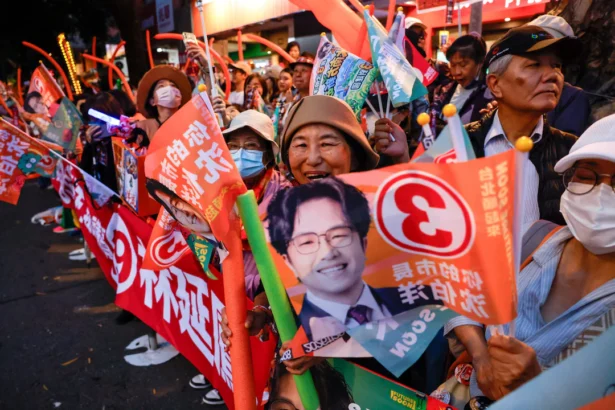

Taiwan is preparing for key local elections on Saturday, with voters set to choose mayors and county chiefs. Although the campaign is largely focused on domestic issues, China has become increasingly involved in the political debate, particularly over the ruling party’s candidate for Taipei mayor.
Puma Shen, a lawmaker from the ruling Democratic Progressive Party (DPP), is seeking to win control of the capital for the party for the first time in nearly three decades. However, his candidacy has drawn strong criticism from Beijing, which accuses him of promoting Taiwan independence and portraying China as a threat to gain votes.
Chinese authorities have labelled Shen a separatist and issued a wanted notice against him. Beijing has also imposed sanctions on his business interests in China, adding to previous restrictions against him. China’s state broadcaster CCTV accused him of exploiting anti-China sentiment during the campaign.
The controversy has intensified concerns in Taiwan about possible interference in the election. Taipei has repeatedly accused Beijing of increasing military activity, cyberattacks and disinformation campaigns ahead of local polls.
Taiwan’s top China policy official, Chiu Chui-cheng, said Beijing had linked its Taiwan policy to the outcome of the island’s elections for years. He warned that attempts to influence voters could instead increase public resentment towards China.
China’s Taiwan Affairs Office did not respond to requests for comment. Beijing has consistently rejected accusations that it interferes in Taiwan’s elections.
Despite the controversy, Shen has largely kept China-related issues out of his campaign speeches. He has focused instead on urban renewal and detailed policy proposals for the capital.
His campaign has attracted a strong following known as the “Ocean Current”. The movement initially gained support from voters concerned about China’s influence and later grew through Shen’s policy-focused approach.
The DPP has a limited electoral history in Taipei. It last held the mayor’s office under Chen Shui-bian, who served from 1994 to 1998 before becoming Taiwan’s first DPP president.
Shen is facing incumbent mayor Chiang Wan-an of the opposition Kuomintang (KMT), a party that traditionally supports closer relations with Beijing. KMT chairwoman Cheng Li-wun met Chinese President Xi Jinping in Beijing earlier this year.
Chiang has also avoided making cross-strait relations a central campaign issue. Instead, he has highlighted local concerns, including water safety and economic development. His administration has also pointed to a deal with US technology company Nvidia to establish a new headquarters in Taipei.
Shen’s growing popularity has reportedly surprised some members of his own party. Two senior DPP officials said he had become a symbol of defiance against Beijing and helped revive a stronger sense of Taiwanese identity.
China’s Taiwan Affairs Office placed Shen on its list of alleged “Taiwan independence” separatists in October 2024. It also sanctioned the Kuma Academy, a civil defence organisation he co-founded that offers courses to prepare civilians for a possible attack from China.
Shen has said Beijing is uncomfortable with his efforts to draw international attention to disinformation and alleged Chinese influence operations. He has urged other countries to remain alert to such activities.
The election campaign has therefore become a test of local political priorities as well as Taiwan’s growing tensions with Beijing. However, the result will be decided by voters, with the focus formally remaining on the leadership of cities and counties across the island.