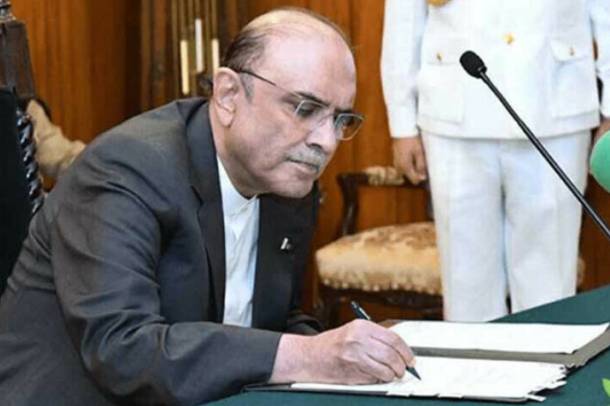

President Asif Ali Zardari on Wednesday approved the National Commission for Minorities Rights Bill 2025, and the Evidence Law Amendment Bill 2025.
The president approved these bills after consultations with Prime Minister Shehbaz Sharif.
The president also gave a nod to the King Hamad University of Nursing and Allied Medical Sciences Bill 2025.
President Asif Zardari says that prior consultation with provincial governments is essential for Danish schools in the provinces.
On December 12, 2025, the parliament had approved long-delayed legislation to establish a National Commission for Minorities Rights, a move welcomed as a step toward protecting non-Muslim communities, including Christians, but criticized by rights advocates for stripping the body of key investigative and enforcement powers.
The National Commission for Minorities Rights Bill 2025 was passed Dec. 2 with a majority vote during a joint session of the National Assembly and Senate, clearing the way for the creation of a government-appointed commission to monitor minority rights and advise authorities.
However, the revised law removes provisions that would have allowed the commission to initiate inquiries or summon officials—changes that have prompted concerns about its independence and effectiveness.
Under the new law, an 18-member commission comprising three Hindus — two from lower caste backgrounds — three Christians, one Sikh, one Baha’i, one Parsee, and two Muslim human rights experts, will investigate minority rights violations, monitor policy implementation, and advise government departments on minority welfare.
Each of the four provinces will nominate a representative from its human rights or minorities department, along with one minority member from Islamabad. Appointments will be made by Pakistan’s prime minister for three-year terms.
The revised legislation, however, strips the commission of the authority to summon witnesses, inspect detention centers, or initiate inquiries on its own — powers included in the earlier May 12 bill which was sent back to the parliament by President Asif Ali Zardari for a wider discussion and review after some parliamentarians and the government objected to granting of “suo motu” powers to the body.
Opposition parties, particularly the Pakistan Tehreek-e-Insaf (PTI) and Jamiat Ulema-e-Islam-Fazl (JUI-F), created a ruckus in the House when Federal Minister for Law and Human Rights Azam Nazeer Tarar tabled the bill for vote.