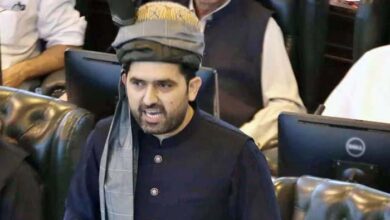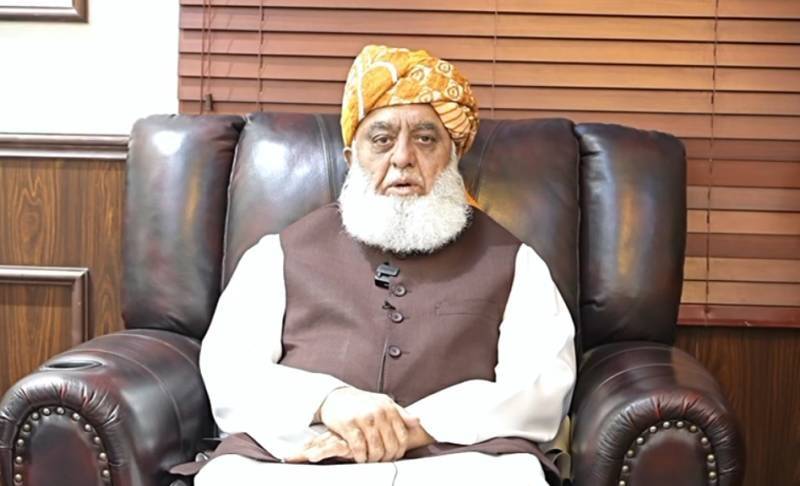

Jamiat Ulema-e-Islam (F) chief Maulana Fazlur Rehman, Thursday announced that an all-party conference (APC) would be held in Karachi on December 22 to oppose what he termed “un-Islamic legislation” in the country.
Talking to the media in Chakwal, Maulana Fazlur Rehman said that religious scholars belonging to different schools of thought would also come together on the same day to register their collective opposition to laws they believe contradict Islamic principles.
He said that lawmakers had taken an oath to uphold the Constitution, adding that un-Islamic legislation could not be accepted under any circumstances.
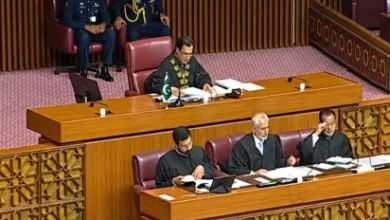
He described the Constitution as a national charter and said that discussions had taken place on the 26th constitutional amendment, which was presented in the assembly with consensus.
However, he alleged that the 27th amendment was passed forcibly with a two-thirds majority. Legislation against the Constitution, he said, amounted to opposition to the Constitution itself, and such actions, in his view, undermine the mandate of the rulers.
Commenting on the current political situation, the JUI-F chief claimed that despite what he called a “fake mandate,” the government in practice belonged only to the Pakistan Muslim League-Nawaz (PML-N), while the Pakistan People’s Party (PPP) was merely providing support.
He alleged that a “fake minority” was ruling the country, adding that while talks in principle were one thing, the real issue was whether dialogue could be implemented in practice.
On the merger of the former Federally Administered Tribal Areas (FATA), Maulana Fazlur Rehman reiterated his party’s opposition, saying they had warned about its possible consequences.
He claimed that institutions which had earlier supported the merger were now admitting it was a wrong decision, and that discussions were now underway about dividing existing provinces.
He said that prudent planning required consideration of outcomes, but alleged that decisions were made under the “intoxication of power.”
According to him, the FATA merger led to armed groups occupying the area, weakening the writ of the state, and now there was talk of vacating the region, which he said reflected inconsistencies in policy.
Referring to Afghanistan and terrorism, Maulana Fazlur Rehman claimed that Pakistan’s Afghan policy and its approach to terrorism had failed over the past 78 years.
He said that “powerful forces” must understand that political decisions should be made by politicians, not by those wielding power.
On the issue of restrictions on meetings with the founder of the Pakistan Tehreek-e-Insaf (PTI), he said he would also raise questions about the arrest and the prevention of meetings.
He clarified that he was neither in favor of arresting politicians nor of banning meetings, adding that the real issue was determining who actually controlled the government and made key decisions, as their impact was borne by the entire nation.