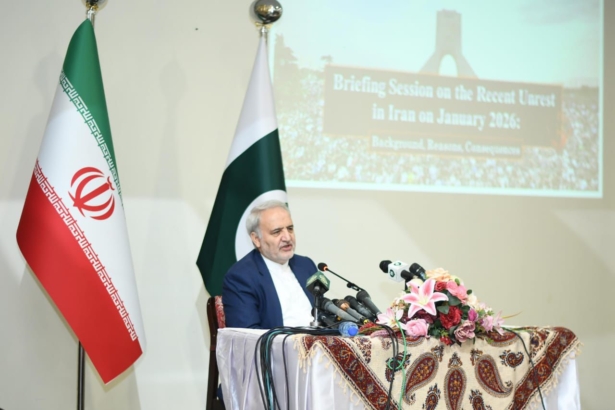

ISLAMABAD: As the U.S. naval presence intensifies in the region, Iran’s Ambassador to Pakistan, Reza Amiri Moghaddam, has laid down Tehran’s strategic “red lines,” signaling that while the window for diplomacy is not closed, it will not be pried open by military coercion.
In a high-stakes press briefing in Islamabad, the Envoy delivered a message that was as much for Washington as it was for the international press corps: Iran is not seeking a “Protectorate” or military intervention from any ally, including Pakistan.
The Diplomacy Deadlock:
A Sabotaged Track in a revelation that sets this report apart from the standard narrative, Ambassador Moghaddam disclosed a significant diplomatic derailment. For the past six months, quiet channels had been active, yet they were abruptly eclipsed by what he termed a “war-like atmosphere” orchestrated by Washington.
* Tehran’s Stance: Mediation is welcome, but it must be a “two-way street.”
* The Message to Mediators: “Success is 50/50. If Pakistan or other friends wish to mediate a ‘win-win’ outcome, they must engage the adversary to halt their aggression first.”
The Cost of Subversion: Beyond the Protests
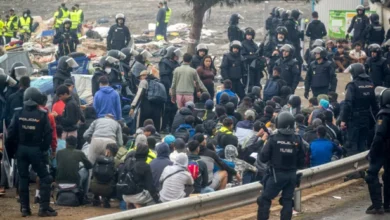
Moving beyond the rhetoric, the Envoy presented a staggering documentation of the internal unrest that began on Dec 28. He provided a data-heavy indictment of foreign interference, detailing how peaceful economic grievances were weaponized into a “kinetic campaign” against the Iranian state.
* The Human Toll: A devastating loss of 2,497 civilians and 3,117 security personnel.
* The Infrastructure Scars: The destruction of 749 police stations, 350 mosques, and even 2 Armenian churches, highlighting that the violence spared no institution.
Regional Realignment:
A Nod to Riyadh and Islamabad in a move that caught diplomatic observers by surprise, the Envoy signaled Tehran’s support for the Pakistan-Saudi Arabia Mutual Defense Agreement. By backing a broader Muslim collective security framework, Moghaddam effectively countered the narrative that Iran seeks regional isolation, while simultaneously dismissing claims of Indian or Afghan state involvement in recent subversion.
A Sharp Rebuke to Leadership Threats
Responding to personal threats against Iran’s Supreme Leader, the Envoy described the U.S. rhetoric as “shameful” and a breach of international law. He cautioned that while Iran harbors no offensive designs against foreign heads of state, its “armed forces have comprehensive, independent plans” to respond to any breach of sovereignty. He added a biting diplomatic postscript: “It is good if U.S. officials like Marco Rubio have finally realized that Iran is not Venezuela.”
[ANALYSIS] Strategic Depth and the ‘Axis’ Question
While the formal briefing focused on state-level defense and internal security, the Ambassador’s tactical silence on the specific future of the ‘Axis of Resistance’ remained the “elephant in the room.” By asserting Iran’s refusal to yield to ‘gunpoint diplomacy,’ the Envoy subtly signaled that Tehran’s regional posture including its alliances with Hamas and Hezbollah remains a non-negotiable component of its security architecture. Despite the tactical pressure of the U.S. Armada, Iran’s refusal to decouple from its strategic depth suggests that these regional alliances remain a critical, intact deterrent.