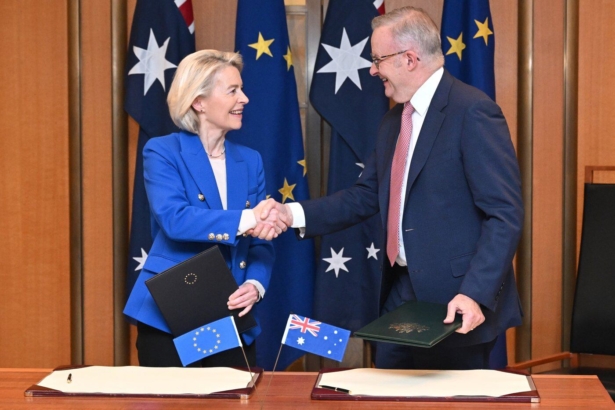

Australia and the European Union have signed a long-awaited trade deal on Tuesday, a partnership eight years in the making that aims to strengthen economic ties, secure critical mineral supplies, and reduce dependence on China. The agreement eliminates tariffs on nearly all European goods entering Australia and on most Australian exports of strategic minerals, a move both sides say will bolster supply chain security and economic growth.
The deal comes amid shifting global trade dynamics. Talks accelerated after the US under Donald Trump imposed significantly higher tariffs, and Western nations expressed growing concern over China’s dominance in rare earths and other critical minerals. In addition to trade, Australia and the EU also formalized new agreements to boost security and defence cooperation, highlighting a broader strategic alignment.
“The EU and Australia may be geographically far apart, but we couldn’t be closer in terms of how we see the world,” European Commission President Ursula von der Leyen said during a press conference in Canberra. “With these dynamic new partnerships on security and defence, as well as trade, we are moving even closer together.”
Australian Prime Minister Anthony Albanese estimated the deal will add roughly A$10 billion ($7 billion) to the Australian economy annually. He emphasized that removing tariffs on Australian critical minerals to the EU will help stabilize global supply chains for essential components in technology, renewable energy, and electric vehicles. “For both Europe and Australia, getting China right is a strategic imperative,” von der Leyen told parliament.
Under the agreement, European wine, sparkling wine, fruit, vegetables, chocolates, and cheeses will see import tariffs removed over a phased timeline. However, some agricultural products, including beef and sheep meat, will remain subject to export quotas, drawing sharp criticism from Australian farmers. Hamish McIntyre, president of the National Farmers Federation, called the agricultural access “subpar” and disappointing after years of negotiations.
Other provisions include full protection for EU geographical indications, such as Pecorino Romano and Ouzo, while some products like feta can continue to use traditional names with proper origin labelling. Australia also lifted its luxury car tax threshold for EU electric vehicles to A$120,000 ($83,600), meaning roughly 75% of EVs from the region will now be exempt from the tax.
Trade between the two sides is already significant, with EU goods exports to Australia reaching €37 billion in 2025 and services totaling €28 billion in 2023. The EU was Australia’s third-largest trading partner in 2024 and the second-largest source of foreign investment.
Analysts say the deal signals a deeper European engagement in the Indo-Pacific, following recent trade agreements with Indonesia and India, and reflects both sides’ determination to secure strategic resources while reducing dependence on a single supplier.
With the deal now in effect, Australia and the EU are positioning themselves not just as trading partners but as strategic allies in an era of shifting global power and economic uncertainty.