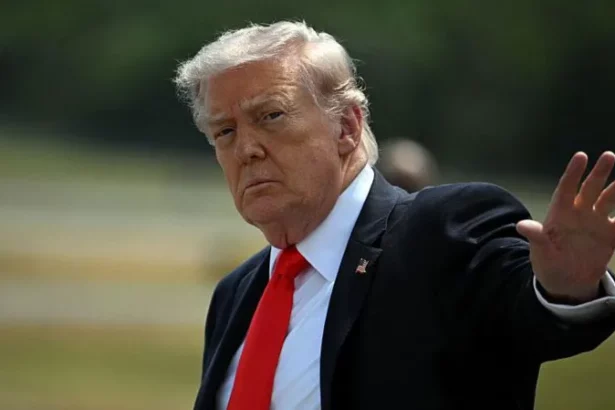

US President Donald Trump announced a new plan to escort stranded vessels out of the Strait of Hormuz starting Monday, warning that any disruption to the operation would be met with force.
Trump said the initiative is intended to assist neutral countries whose ships have been caught in the ongoing conflict. His announcement came shortly after Tehran confirmed it had received Washington’s response to its 14-point proposal to end the war, conveyed through Pakistan, and was reviewing it.
Trump had earlier voiced dissatisfaction with the proposal and cautioned that hostilities could resume if Iran “misbehaved”. At the same time, Iran’s Revolutionary Guards (IRGC) adopted a tougher tone, telling the US president to choose between “impossible” military action or a “bad deal”.
In a post on Truth Social, Trump said multiple countries had approached Washington for help in freeing ships “locked up” in the vital waterway despite having “absolutely nothing to do” with the conflict. He described these vessels as “neutral and innocent bystanders”.
He stated that the United States would “guide their ships safely out of these restricted waterways” so they could resume normal commercial operations. He added that US officials had been directed to make their “best efforts” to ensure the safe evacuation of both vessels and their crews.
“This initiative, Project Freedom, will begin Monday morning, Middle East time,” Trump said, adding that it was meant to assist “people, companies, and countries that have done absolutely nothing wrong — they are victims of circumstance.”
“If, in any way, this humanitarian process is interfered with, that interference will, unfortunately, have to be dealt with forcefully,” he warned, noting that many vessels were running short of food and essential supplies required for large crews.
Trump described the effort as a “humanitarian gesture” by the US and Middle Eastern countries, “but particularly, the country of Iran”. He added that US representatives were engaged in “very positive discussions” with Tehran that could “lead to something very positive for all”.
The move comes amid continued instability in and around the Strait of Hormuz, a critical global shipping route where tensions have disrupted maritime traffic and raised concerns over supply chains and regional security.
Earlier, Tehran warned Washington it must choose between an “impossible” military option or a “bad deal”, even as fragile diplomatic efforts continued in a volatile regional environment.
Iran’s Tasnim and Fars news agencies reported that Tehran had submitted a 14-point proposal through Pakistan, though Trump questioned its effectiveness. Speaking in West Palm Beach, Florida, he said Iran had “not yet paid a big enough price” and reiterated that renewed strikes remained an option.
Despite the ceasefire entering its fourth week, rhetoric on both sides has intensified. The IRGC repeated that Trump must choose between “an impossible operation or a bad deal” with Iran.
As positions harden, the path forward remains uncertain. The crisis has highlighted the limits of both military pressure and diplomacy, leaving the region suspended between escalation and a fragile peace.
Observers say backchannel diplomacy remains active, with the coming week seen as potentially crucial. Attention is also focused on a possible diplomatic opening ahead of Trump’s planned visit to Beijing later this month. Pakistan is believed to be increasing efforts to bridge differences and facilitate further dialogue.
Iran’s Ambassador to Pakistan, Reza Amiri-Moghaddam, confirmed that Islamabad continues to play a central mediating role. Speaking to IRNA, he said progress would depend on changes in US conduct and meaningful diplomatic engagement.
Iranian state media reported that Tehran’s proposal seeks to resolve all issues within 30 days instead of prolonging the ceasefire. It includes guarantees against renewed attacks, withdrawal of US forces, lifting of the naval blockade, release of frozen assets, compensation for damages, removal of sanctions, and an end to hostilities across all fronts, including Lebanon.
In a late-night statement, Iran’s Foreign Ministry spokesperson Esmaeil Baghaei said the US response had been received via Pakistan and was currently under review.