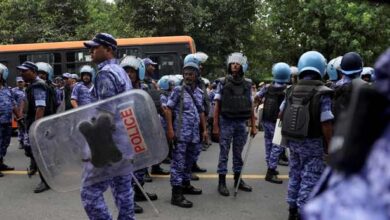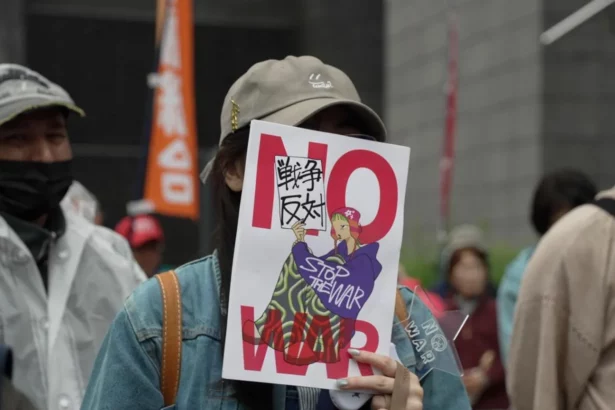

Under grey skies and relentless rain, thousands of protesters filled the streets outside Japan’s prime minister’s office in Tokyo this week, waving soaked banners and chanting a message growing louder across the country: “No War.”

What began as scattered demonstrations has now evolved into Japan’s biggest anti-war protest movement in decades, reflecting rising public anxiety over the country’s changing military direction under Prime Minister Sanae Takaichi.

Since taking office in October 2025, Takaichi has introduced sweeping defence reforms that many believe are pulling Japan away from its deeply rooted pacifist identity established after World War II.
Her government recently lifted long-standing restrictions on exporting lethal weapons and expanded Japan’s overseas military role, arguing that rising tensions in East Asia require stronger national defence capabilities.
But for many Japanese citizens, especially younger generations and survivors of wartime trauma, the changes are reviving painful historical fears.
A Nation Built on Pacifism Faces a Turning Point
After Japan’s defeat in World War II, the country adopted a constitution shaped by a powerful anti-war philosophy.
At the centre of that identity is Article 9, the famous “pacifist clause” that renounces war and prohibits Japan from maintaining armed forces for combat purposes.

Although Japan later created self-defence forces through reinterpretation of the constitution, Article 9 remained a symbol of the country’s promise never to return to militarism.
Now, that promise is being debated more fiercely than at any time in recent years.
Takaichi says Japan’s security environment has fundamentally changed. With an increasingly assertive China, missile threats from North Korea, and regional tensions involving Russia, she argues Japan can no longer rely solely on its post-war framework.
The United States, Japan’s closest ally, has also encouraged Tokyo to play a more active security role in the Indo-Pacific region.
Young Voices Join the Streets

Unlike many previous demonstrations dominated by older generations, this protest movement includes large numbers of young Japanese citizens worried about what the future could hold.
Outside government buildings in Tokyo, protesters carried handmade lanterns, peace signs, and banners calling for dialogue instead of militarisation.
Akari Maezono, a woman in her 30s attending the rally, said she felt angry that major policy shifts were happening without broader public consultation.
“These changes affect all of us,” she said. “We should have a voice before Japan moves further toward becoming a military power.”
Social media platforms, especially X, have played a major role in spreading awareness about the demonstrations, helping organise rallies not only in Tokyo but also in cities including Osaka, Kyoto, and Fukuoka.

Attendance has reportedly increased week after week.
In a society often known for political restraint and social harmony, analysts say the growing size of the protests reflects deep emotional concerns rather than ordinary political disagreement.
Memories of Hiroshima and Nagasaki Still Shape Debate
For many Japanese families, opposition to war is not merely political—it is personal.
The atomic bombings of Hiroshima and Nagasaki in 1945 killed around 200,000 people by the end of that year and left lasting trauma across generations.
Survivors of the bombings, known as hibakusha, continue to advocate for peace and nuclear disarmament.
Speaking recently at a United Nations conference, survivor Jiro Hamasumi warned against abandoning Japan’s pacifist ideals.
“Nuclear weapons were used because we went to war,” he said. “No more war, no more hibakusha.”
Those words resonate strongly with protesters who fear that expanding military powers could eventually draw Japan into foreign conflicts.
Some demonstrators pointed to recent global tensions, arguing that Japan’s pacifist constitution has protected the country from direct involvement in overseas wars for decades.
Supporters of Defence Reforms Say Japan Must Adapt
Not everyone opposes the government’s direction.
Supporters of Takaichi’s policies argue that the modern world is far more dangerous than the one Japan faced in 1947 when the constitution was written.
They believe Japan must strengthen deterrence capabilities to protect itself and support allies during regional crises.
Many conservatives say Article 9 has become outdated and too restrictive, preventing Japan from responding effectively to security threats.
For them, military reform is not about reviving wartime nationalism but ensuring national survival in an increasingly unstable geopolitical landscape.
Recent opinion polls show the country remains sharply divided, with public sentiment split between strengthening defence and preserving pacifism.
A Country at a Crossroads
As night fell over Tokyo, protesters continued chanting beneath glowing city lights while police monitored the peaceful demonstrations.
Inside a nearby convenience store, one cashier quietly expressed frustration at the growing rallies.
“They’re always here now,” he said before pausing briefly. “Maybe it’s time for a new Japan.”
That simple comment captured the deeper debate unfolding across the country.
Japan now faces a defining question: whether to hold tightly to the pacifist identity shaped by the devastation of World War II—or reshape itself to confront what leaders describe as a dangerous new era.
In a nation where change often comes slowly and carefully, the answer may determine Japan’s future role not only in Asia, but on the global stage itself.