NASA’s next great eye in the sky, the golden-mirrored James Webb Space Telescope, passed a key review this week, bringing it one step closer to launching in November and observing new parts of the cosmos for scientists here on Earth.
That’s good news for the United States’ space agency, which has spent the last several weeks trying to troubleshoot issues with its current window on the universe, the Hubble Space Telescope.
The storied telescope that has revolutionised our understanding of the cosmos for more than three decades is experiencing a technical glitch. According to NASA, the Hubble Space Telescope’s payload computer, which operates the spacecraft’s scientific instruments, went down suddenly on June 13.
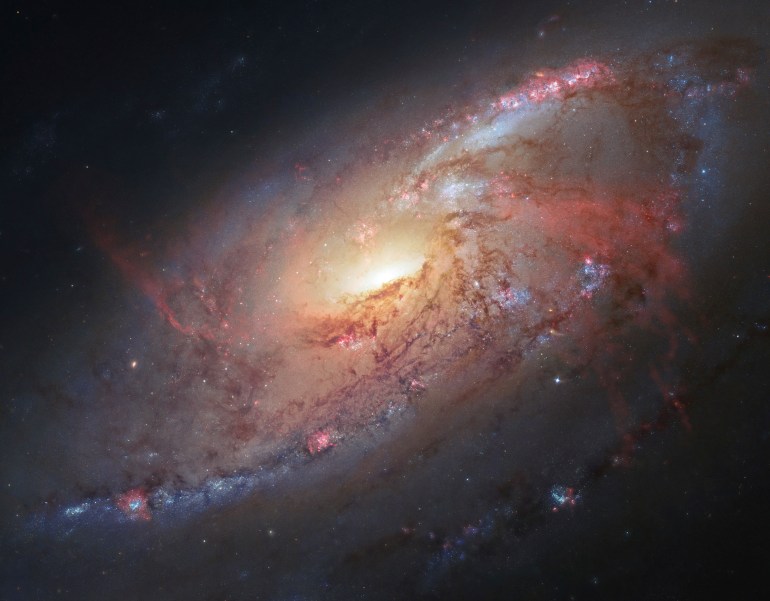 During its more than 30 years in the sky, the Hubble Space Telescope has captured stunning images like this one of the Messier 106 galaxy [File: STScI/AURA, R Gendler via AP]
As a result, the instruments on board meant to snap pictures and collect data are not currently functioning. The agency’s best and brightest have been working diligently to get the ageing telescope back online and have run a barrage of tests but still can’t seem to figure out what went wrong.
“It’s just the difficulty of trying to fix something orbiting 400 miles [653 kilometres] over your head instead of in your laboratory,” Paul Hertz, the director of astrophysics for NASA, told Al Jazeera.
“If this computer were in the lab, it would be really quick to diagnose it,” he explained. “All we can do is send a command, see what data comes out of the computer, and then send that data down and try to analyse it.”
Hubble’s legacy
When Hubble launched on April 24, 1990, scientists were excited to peer into the vast expanse of space with a new set of “eyes”, but they had no idea how much one telescope would change our understanding of the universe.
The telescope has looked into the far reaches of space, spying the most distant galaxy ever observed — one that formed just 400 million years after the big bang.
 This image taken with the Hubble Space Telescope shows a hot, star-popping galaxy that is farther than any previously detected, from a time when the universe was a mere 400 million years old [File: Space Telescope Science Institute via AP]
Hubble has also produced stunning galactic snapshots like the Hubble Ultra Deep Field.
Captured in one single photograph are hundreds of thousands of ancient galaxies that formed long before the Earth even existed — each galaxy a vast and thriving stellar hub, where hundreds of billions of stars were born, lived their lives, and died.
The light from these galaxies has taken billions of years to reach Hubble’s sensors, making it a time machine of sorts – one that takes us on a journey through time to see them as they were billions of years ago.
Hubble has also spied on our cosmic neighbours, discovering some of the moons around Pluto.
Its observations showed us that almost every galaxy has a supermassive back hole at its centre, and Hubble has also helped scientists create a vast three-dimensional map of an elusive, invisible form of matter that accounts for most of the matter in the universe.
Called dark matter, the enigmatic substance can’t be seen. Scientists only know it exists by measuring its effects on ordinary matter. Thanks to Hubble’s suite of scientific instruments, scientists were able to create a 3D map of dark matter.
What went wrong
Scientists have been planning for Hubble’s inevitable demise for quite some time. Over the past 31 years, the telescope has seen its fair share of turmoil.
Shortly after it launched, NASA discovered that something wasn’t quite right: Hubble’s primary mirror was flawed. The telescope is the only one in NASA’s history that was designed to be serviced by astronauts.
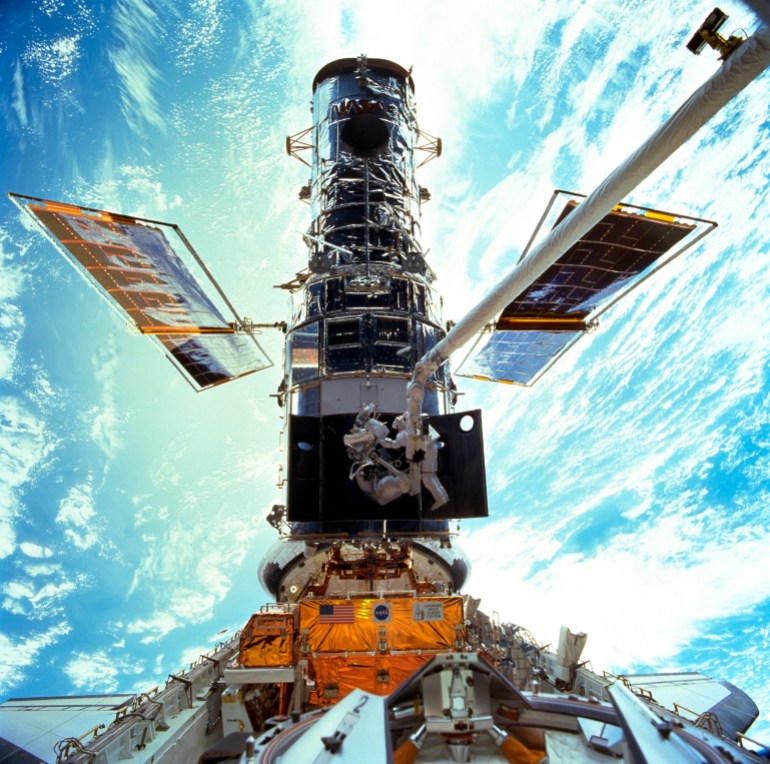 Astronauts Steven L Smith and John M Grunsfeld serviced the Hubble Space Telescope during a December 1999 mission [File: NASA/JSC via AP]
Over its lifetime (and the course of the agency’s shuttle programme), groups of NASA astronauts have repaired and upgraded Hubble and its instruments five different times.
When the space shuttle retired in 2011, it meant that Hubble would be on its own. If the telescope were in trouble, ground controllers would need to troubleshoot remotely.
So far that has proven to be effective. That is, until June 13.
Just after 4pm EDT (20:00 GMT), an issue with the observatory’s payload computer popped up, putting the telescope and its scientific instruments into safe mode.
Hubble has two payload computers on board — the main computer and a backup for redundancy. These computers, called a NASA Standard Spacecraft Computer-1 (or NSSC-1), were installed during one of the telescope’s servicing missions in 2009; however, they were built in the 1980s.
They’re part of the Science Instrument Command and Data Handling (SI C&DH) unit, a module on the Hubble Space Telescope that communicates with the telescope’s science instruments and formats data for transmission to the ground. It also contains four memory modules (one primary and three backups).
The current unit is a replacement that was installed by astronauts on shuttle mission STS-125 in May 2009 after the original unit failed in 2008.
When the main computer went down in June, NASA tried to activate its backup, but both computers are experiencing the same glitch, which suggests the real issue is in another part of the telescope.
Currently, the team is looking at the various components of the SI C&DH, including the power regulator and the data formatting unit. If one of those pieces is the problem, then engineers may have to perform a more complicated series of commands to switch to backups of those parts.