
KARACHI: Raees Qabool Mohammad Khatian, the Chairman of the Sindh Irrigation and Drainage Authority (SIDA), has said that under the Sindh Water and Agriculture Transformation (SWAT) project, efforts should not only focus on increasing agricultural production with reduced water usage, but also on improving its quality and protecting it from pollution, so that clean drinking water can be ensured for the people of Sindh.
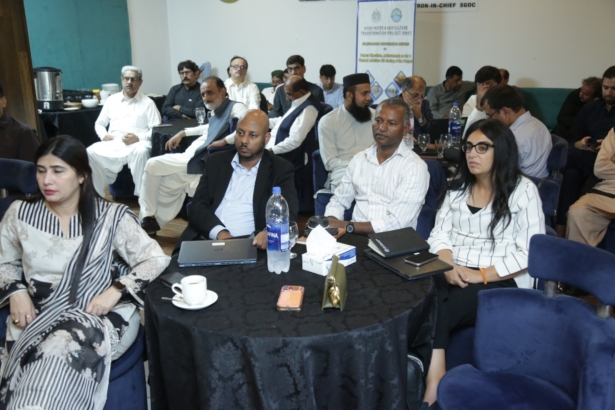
He expressed these views while addressing a stakeholder workshop held at the Government Officers Club in Karachi to review the performance of the SWAT project. He further said that the Government of Sindh had carried out irrigation development works in Badin district, including the rehabilitation of the Phuleli Canal and its distributaries.
As a result, the Phuleli Canal is now capable of carrying 20,000 cusecs of water. Improved water supply to tail-end areas has brought 400,000 acres of barren land under cultivation in Badin, leading to a 60% increase in the production of rice and other crops.
He acknowledged that there had been delays in the rehabilitation of Akram Canal, but assured that the work would now be completed soon. He added that the canal’s water carrying capacity was being enhanced to further improve water supply to tail-end areas.
World Bank Task Team Leader Françis Onimus stated that the objectives of the SWAT project are clear: to achieve higher agricultural productivity in Sindh with lower water usage. He said that farmers would be provided with facilities and the irrigation system will be improved to ensure water reaches tail-end areas. He also mentioned that the workshop was originally planned at Sindh Agriculture University, Tando Jam, but was shifted due to security concerns.
Project Director of the Irrigation Component of SWAT, Jamal Mangan, said that work on Akram Canal could not begin due to design changes by consultants. He emphasized that such canal rehabilitation projects occur after decades, so no work should be undertaken that might fail again. He added that tenders for Akram Canal had been opened and a decision would be made within a week.
He also informed that the feasibility study for Right Bank Canals had commenced, and tenders for modernization of distributaries had also been opened, with work would begin soon. Project Coordinator Nazir Essani said that unfortunately, despite three years having passed, no significant work could be demonstrated in the performance review workshop due to several reasons.
However, all preparations for project design and field implementation have been completed. These include initiation of the Right Bank feasibility study, finalization of Akram Canal design, completion of canal modernization trainings, and development of hydro-agro informatics systems.
The project is expected to be completed within the remaining three years. Chairman of the Nara Canal Area Water Board, Syed Mumtaz Shah, stated that farmers have always supported effective projects that contribute to the development of the irrigation system. He suggested that modernization of distributaries should first be implemented on one channel, and after evaluating its results, extended to others.
The Project Director of the Agriculture Development Unit (SWAT), Imdad Soho, said that Climate Smart Schools had been established and 750 farmers out of 1,223 from three farmer organizations have been trained.
He added that mapping of rising groundwater levels and saline land will be completed in nine districts by June, while schemes for remaining districts have been submitted for approval. Chairman of the Kot Ghulam Mohammad Minor Farmers Organization, Anwar Khan, highlighted that 2,000 acres of land in their command area waa barren, while the project only covered reclamation of 150 acres.
He urged that this limit be increased to rehabilitate all barren land in the area. Representative of the Sindh Chamber of Agriculture, Nabi Bakhsh Sathio, suggested that performance review and consultative workshops with farmers should be held every six months. He also recommended collecting video feedback from farmers after project completion to learn from its successes and shortcomings.
Representative of the Sindh Abadgar Board, Mohammad Aslam Mari, stated that water management and distribution are not satisfactory, causing losses to farmers. He recommended providing subsidies and training to farmers, along with solar tube wells and drainage systems for agricultural lands.
SIDA Board Member Miss Sadaf Kerio emphasized the need to provide women with washing areas, water collection facilities, and shelters to protect them from heat while working in fields. Another board member, Miss Mah Rukh Talpur, stressed the importance of providing agricultural training to women. The workshop was attended by a large number of farmers, officials, and representatives from SIDA, Area Water Boards, and farmer organizations.