

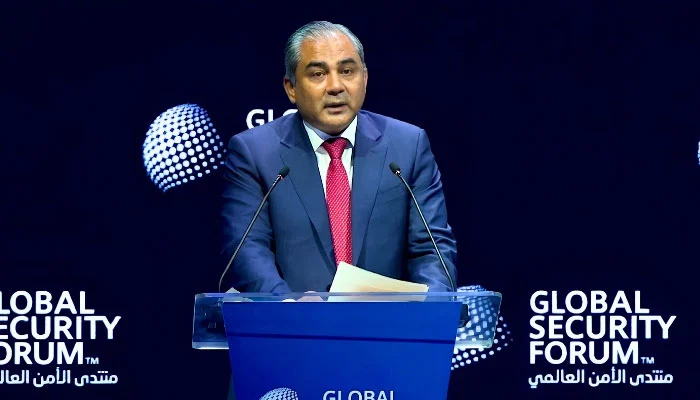

DOHA: Interior Minister Mohsin Naqvi has said achieving peace between the United States and Iran requires patience, trust and sustained efforts, stressing that lasting peace cannot be secured in a single meeting.
Addressing the Global Security Forum in Doha on Monday, Naqvi said Pakistan had made every possible effort to bring Washington and Tehran to the negotiating table. He added that there were moments when tensions escalated sharply, but Islamabad did not give up its efforts.
His remarks come amid mounting regional tensions, as Yemen’s internationally recognised government forces continue to fight Houthi rebels, who are also targeting Saudi Arabia.
The kingdom reported intercepting four drones on Saturday, followed by further interceptions on Sunday, amid repeated Houthi attacks.
Meanwhile, efforts to revive US-Iran dialogue remain stalled, with both sides at odds over the terms for resuming negotiations.
Iranian Foreign Minister Abbas Araghchi said on Sunday that Tehran’s proposal to reopen the Strait of Hormuz within seven days remained on the table, but progress depended on Washington’s response to Iran’s conditions.
Iran’s demands include lifting the US blockade on its ports, easing sanctions on its oil exports and ending hostilities across regional fronts, while Washington wants Iran’s nuclear programme addressed as a priority.
Against this backdrop, Naqvi praised Qatar’s diplomatic efforts to mediate between the United States and Iran, saying Islamabad and Doha had worked together to prevent further escalation in the region.
“Peace cannot be achieved in a single meeting. It requires patience, trust and continuous efforts,” Naqvi said, underscoring the need for sustained diplomatic engagement to resolve conflicts.
The interior minister also said Chief of Defence Forces (CDF) Field Marshal Syed Asim Munir and Qatari Prime Minister Sheikh Mohammed bin Abdulrahman bin Jassim Al Thani had worked for more than 16 hours without a break during the Swiss peace talks.
Naqvi cited the Makkah Joint Defence Agreement (MJDA), involving Pakistan, Saudi Arabia and Turkiye, as an example of Islamabad’s commitment to regional security, emphasising that the pact was intended to promote peace rather than war.
The security czar’s statement came a day after Inter-Services Public Relations (ISPR) Director General Lt Gen Ahmed Sharif Chaudhry warned that the MJDA’s collective deterrence could come into play if negotiations failed and the regional crisis escalated into military conflict.
In an interview with Independent Arabia aired on Sunday, he described the alliance as defensive in nature and said it was not directed against any particular country.
Pakistan, Saudi Arabia and Turkiye signed the MJDA on August 7 during the Makkah Al-Mukarramah Summit for Joint Defence.
Under the agreement, an armed attack against any one of the three signatories is to be regarded as an attack against all three, establishing a mutual-defence commitment among the countries.