

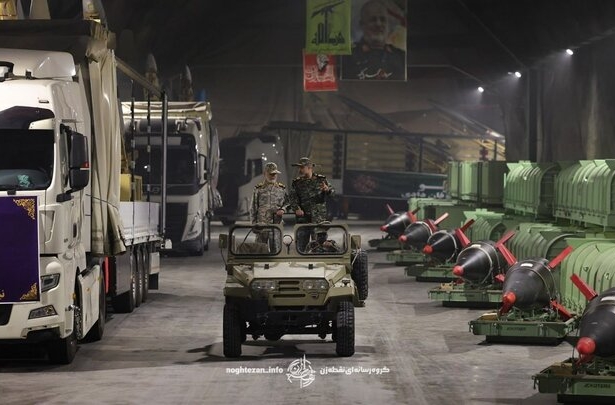

TEHRAN: Iran’s Islamic Revolutionary Guard Corps (IRGC) Aerospace Force has unveiled a new underground missile city, showcasing its expanding military infrastructure and efforts to strengthen its missile and drone capabilities.
The unveiling ceremony was attended by Armed Forces Chief of Staff Major General Abdollahi and IRGC Aerospace Force Commander Brigadier General Seyyed Majid Mousavi, along with other senior military officials.
During the event, military officials inspected sections of the underground complex and reviewed the capabilities and operational readiness of the missile units stationed there.
Addressing the ceremony, General Abdollahi said Iran’s advanced missile systems would surprise its adversaries through their impact on the battlefield.
The announcement follows a statement by IRGC spokesperson Brigadier General Hossein Mohebbi on November 7, who said the Aerospace Force was preparing to unveil a new underground missile city alongside several other military developments.
Mohebbi described the development as a major advancement in Iran’s defence programme, saying the country had shifted much of its missile and drone production infrastructure from surface facilities to underground locations.
He said Iran was moving beyond underground storage facilities towards establishing what he called “missile production cities” deep beneath the ground. These facilities, he added, were intended to maintain manufacturing capabilities and protect critical military infrastructure during wartime.
The IRGC spokesperson also outlined several achievements of the Aerospace Force, highlighting Iran’s progress in developing indigenous aerospace technology and reducing dependence on foreign military equipment.
He claimed that domestic expertise had enabled Iran to move from importing military equipment to producing and exporting advanced weapons systems. Among the examples he cited were Shahed-136 drones, Arman missiles, 358 drones and the third Khordad air defence system.
Mohebbi also highlighted the force’s claimed ability to maintain missile and drone production despite heavy bombardment and wartime pressure. He said flexible manufacturing arrangements had been developed to ensure the continued supply of military equipment during conflict.
On operational capabilities, the spokesperson claimed that Iranian forces had intercepted and destroyed more than 260 enemy aircraft and aerial vehicles during the US-Israeli war against Iran. He listed F-35, F-16, F-5 and F-18 fighter jets, along with MQ-1, RQ-4, Orbiter and Lucas drones.
However, these figures and claims have not been independently verified.
Mohebbi further claimed that Iran had improved the stealth capabilities of its missiles and drones by reducing their radar signatures, allowing them to penetrate sophisticated air defence networks. He also questioned the effectiveness of systems such as THAAD and Patriot against Iran’s advanced weapons.
He said Iran’s deterrence strategy included the ability to target military and strategic infrastructure in response to attacks. He also pointed to cooperation between the Aerospace Force and domestic universities, research institutions, scientific centres and industrial organisations as an important factor behind its technological progress.
The spokesperson indicated that Iran had developed additional military capabilities that had not yet been made public. He said further achievements could be unveiled if another round of confrontation with its adversaries took place.
Iran’s underground missile facilities form an important part of its military strategy, providing protected infrastructure for missile storage, production and operational readiness. The latest unveiling highlights Tehran’s continued efforts to strengthen its defence capabilities and maintain strategic deterrence amid heightened regional tensions.