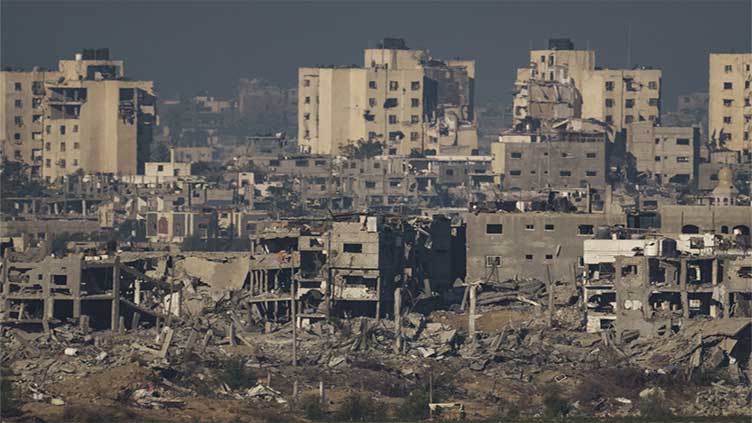

NEW YORK: The Gaza Strip is in ruins.There are hills of rubble where apartment blocks stood, and pools of sewage-tainted water spreading disease.
City streets have been churned into dirt canyons and, in many places, the air is filled with the stench of unrecovered corpses.
Israel’s yearlong offensive against Hamas, one of the deadliest and most destructive in recent history, has killed more than 41,000 people, a little over half of them women and children, according to local health officials. With no end in sight to the war and no plan for the day after, it is impossible to say when – or even if – anything will be rebuilt.
Even after the fighting stops, hundreds of thousands of people could be stuck living in squalid tent camps for years. Experts say reconstruction could take decades.
“This war is destruction and misery. It would make the stones cry out,” said Shifaa Hejjo, a 60-year-old housewife in a tent pitched on land where her home once stood. “Whoever sees Gaza … It will make them cry.”
Israel blames the destruction on Hamas. Its Oct. 7 attack on Israel — in which some 1,200 people were killed and around 250 taken hostage — ignited the war. Israel says Hamas embedded much of its military infrastructure, including hundreds of kilometers (miles) of tunnels, in densely populated areas where some of the heaviest battles were fought.
The fighting left roughly a quarter of all structures in Gaza destroyed or severely damaged, according to a U.N. assessment in September based on satellite footage. It said around 66% of structures, including more than 227,000 housing units, had sustained at least some damage.
If there’s a cease-fire, around half of all families “have nowhere to go back to,” said Alison Ely, a Gaza-based coordinator with the Shelter Cluster, an international coalition of aid providers led by the Norwegian Refugee Council.
Almost as many buildings have been destroyed or damaged in Gaza as in all of Ukraine after its first two years of war with Russia, according to Corey Scher and Jamon Van Den Hoek, U.S.-based researchers who use satellite radar to document the wars’ devastation.
To put that into perspective: Gaza is less than half the size of Ukraine’s capital, Kyiv.
The amount of destruction in central and southern Gaza alone, Scher said, is roughly equivalent to what was lost in the front-line town of Bakhmut, the scene of one of the deadliest battles in the Ukraine war and where Russian forces destroyed nearly every building in their path to force Ukrainian troops to withdraw. The destruction in northern Gaza is even worse, he said.