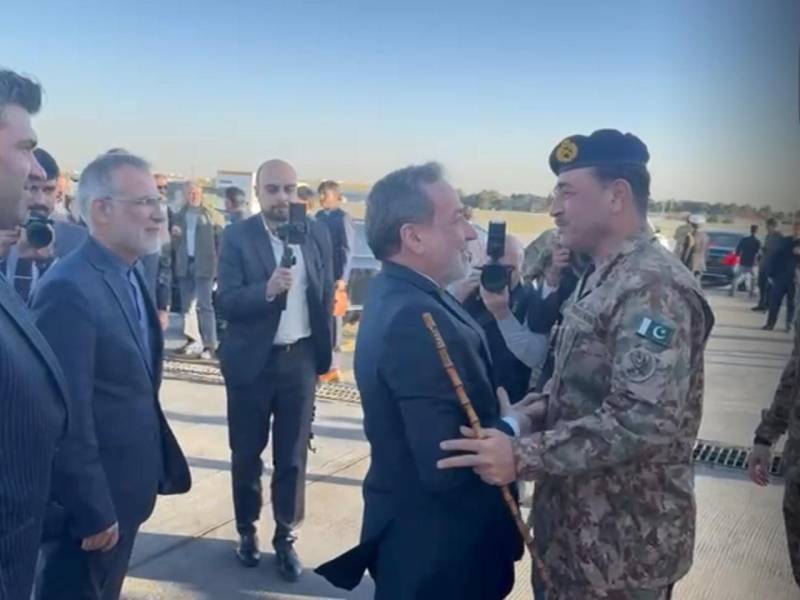

A high-level Pakistani delegation headed by Syed Asim Munir arrived in Iran on Wednesday as part of ongoing diplomatic efforts aimed at easing regional tensions and facilitating dialogue between Tehran and Washington.
According to the Inter-Services Public Relations (ISPR), Federal Interior Minister Mohsin Naqvi is also part of the visiting delegation. Upon arrival, the delegation was received by Iranian Foreign Minister Abbas Araqchi.
The visit is being seen as part of Pakistan’s broader reconciliation efforts in the region.
Media reports, including those by Al Jazeera, suggest that the Pakistani delegation is expected to convey messages from the United States to Iranian authorities, while also discussing the possibility of a second round of negotiations.
Iran confirmed that diplomatic exchanges with the United States have continued through Pakistan following the recent round of talks that concluded without a breakthrough. Iranian Foreign Ministry spokesman Esmaeil Baqaei stated during a weekly briefing that multiple messages had been relayed via Pakistan since Sunday, when the Iranian delegation returned to Tehran.
“Today, we are very likely to receive a Pakistani delegation as a continuation of the discussions in Islamabad,” Baqaei said, indicating the importance of Islamabad’s intermediary role.
Earlier, Iranian President Masoud Pezeshkian reiterated Tehran’s willingness to engage in negotiations, while emphasizing that Iran does not seek war or instability in the region. He, however, warned that any attempt to force Iran into submission would fail, reaffirming the country’s strategic stance.
On the US side, President Donald Trump said in a recent interview that tensions with Iran were close to easing, claiming that Tehran was seeking a deal. He expressed confidence that the conflict was nearing its conclusion, while reiterating that Washington would not allow Iran to develop nuclear weapons.
Trump also suggested that rebuilding efforts in the region could take decades and warned that Iran acquiring nuclear capability would significantly disrupt the global balance.
Separately, US Vice President JD Vance, speaking at the University of Georgia, said a ceasefire between Washington and Tehran remained intact despite longstanding mistrust. He described the current dialogue as the highest-level engagement between the two countries in nearly five decades, while acknowledging that a comprehensive agreement had yet to be finalized.
Vance noted that the United States was pursuing a broad-based agreement that would serve both national and international interests, expressing cautious optimism over the direction of ongoing diplomatic efforts.
The visit by the Pakistani delegation is being closely watched as a potential step toward reviving stalled negotiations and reducing tensions in the region.