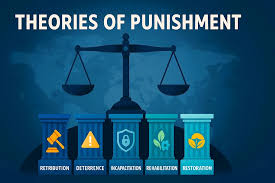

In criminal jurisprudence, punishment is generally explained through five major theories, each reflecting a different philosophical justification for why the state punishes offenders. These theories are widely discussed in criminal law, penology, and justice policy.
1. Retributive Theory: This theory is based on the idea that punishment is morally justified because the offender deserves it. The offender must suffer in proportion to the harm caused by the crime. This theory focuses on the offender’s moral responsibility. It stresses that punishment should be proportionate to the crime and it looks backward at the past act, not future consequences. For example, if someone commits murder, severe punishment such as life imprisonment or death sentence is justified because the offender deserves punishment for the harm caused. Philosophers such as Immanuel Kant and Hegel are in favour of this theory.
2. Deterrent Theory: This theory argues that punishment is necessary to prevent future crimes by creating fear of punishment so that punishment discourages crime. It has two forms: 1) General Deterrence, which is that punishing one offender sends a message to society that crime will be punished, 2) Specific Deterrence which means that punishment prevents the same offender from committing crime again. For example, strict penalties for corruption or drug trafficking aim to discourage others from committing similar offences.
3. Preventive (Incapacitation) Theory: This theory focuses on protecting society by preventing the offender from committing further crimes, i.e. Remove the offender’s ability to commit crime. For example, keeping a habitual violent offender in prison prevents him from harming society.
4. Rehabilitative Theory: The reformative theory views crime as often resulting from social, psychological, or economic factors, and therefore focuses on reforming the offender rather than simply punishing him, i.e., changing the offender into a law-abiding citizen. In this system, various methods are utilized such as education and vocational training, psychological counselling, probation and parole, and juvenile rehabilitation programmes. This theory is particularly important in juvenile justice systems, where the focus is on rehabilitation rather than punishment. There is a special focus on the rehabilitation of juveniles in the Juvenile Justice System Act, 2018. The Act mendates to establishe Juvenile Rehablitation Centres in Pakistan which is a designated facility where a child in conflict with the law is placed not for punishment, but for structured care and development. Such centres provide education, vocational and technical training, along with psychological and moral guidance, aimed at reintegrating the juvenile into society as a responsible and law-abiding individual.
5. Restorative Theory: This modern theory focuses on repairing the harm caused by crime by involving the victim, offender, and community. The main idea of this theory is that Justice should restore relationships and repair harm. This theory uses various methods for the restorative justice system such as victim-offender mediation, community service, restitution or compensation, and community reconciliation processes. This approach is increasingly used in juvenile justice and community-based justice systems.
Child victims are more vulnerable to victimization than adults due to their developmental immaturity, limited knowledge, experience, and self-control. Traditional court proceedings often overlook the needs and requests of victims, and restorative justice goes against this image. Restorative justice typically targets youths who have committed minor or nonviolent offences, but some programmes also accept those who have committed violent crimes. It is suggested that people convicted of different types of offences may participate in varying restorative justice programmes based on the level of risk they present to the community. Victims may prefer restorative justice practices because they give them agency and offer possibilities for addressing and repairing the harm that traditional criminal prosecution cannot.
Restorative justice is an evidence-based intervention for children in conflict with the law, focusing on learning and reintegration. The Convention on the Rights of the Child and other human rights instruments emphasize the importance of learning from mistakes and reintegrating children into society. Child-friendly justice is another term that needs to be addressed, and restorative approaches have become part of pedagogical and child-friendly procedures. Restorative justice is a communication process that actively implements the child’s right to be heard. It creates a safe space for children to take responsibility and be involved in all matters that concern them. The aim is to create the possibility for the harm-doer and victim to meet or share information to see if things can be restored and plan for the future. Restorative justice interventions should be prioritized with a focus on reintegration, support, and empowerment for children in conflict with the law. Restorative justice for young people should be done in a child-friendly way by specially trained personnel, with attention to power imbalances and safety in preparations, meetings, and aftercare. Restorative justice has the potential to be extremely relevant in dealing with child justice, as children are the future and communities have a responsibility in supporting their growth.
Juvenile justice is grounded in a rehabilitative approach that seeks to reform the child offender, with its ultimate aim being the realization of restorative justice through repairing harm and rebuilding relationships among the offender, the victim, and the community.