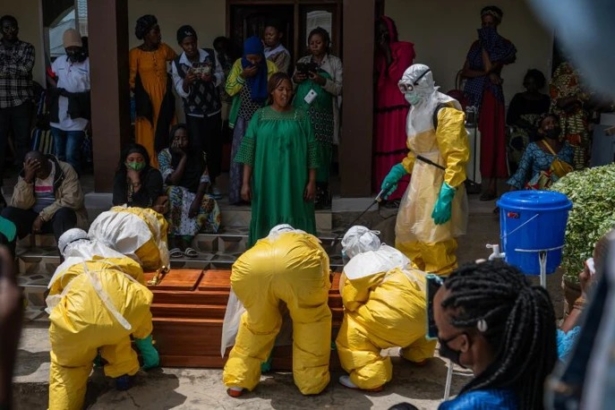

KINSHASA: A specialised medical containment team has been targeted in a violent community assault in the eastern Democratic Republic of Congo, forcing health workers to abandon an infected coffin and stoking fears of an uncontained viral surge.
The confrontation took place in Katana, a town situated in the South Kivu province currently under the administrative control of AFC/M23 rebel forces.
The targeted deployment consisted of a burial team, whose personnel are specifically trained to inter highly contagious bodies under rigorous health protocols designed to block transmission.
Following the forced retreat of the medical unit, members of the local community stepped in to handle the highly infectious body independently.
Epidemiologists have repeatedly warned that amateur handling of deceased victims remains a primary driver for launching fresh chains of infection during a filovirus crisis.
The underlying catalyst for the hostile reception has not been officially detailed, though regional health administrators report a spike in local skepticism, with several grieving families actively challenging official medical causes of death.
A nearly identical clash occurred simultaneously in Bunia, the administrative capital of Ituri province, where an aggressive crowd confronted a response unit at a burial site, leaving at least four humanitarian workers injured.
The rising administrative friction arrives as the country faces a rapid expansion of the rare Bundibugyo strain of Ebola, a variety for which there is currently no approved vaccine or standard therapeutic cure.
Since the formal declaration of this outbreak on May 15, the 17th in the nation’s history, the central health ministry has validated 363 confirmed infections alongside 62 documented fatalities.
The latest case metrics indicate that the epidemic has successfully expanded across 17 independent health zones within Ituri province, whilst simultaneously seeding active clusters in North Kivu and South Kivu.